
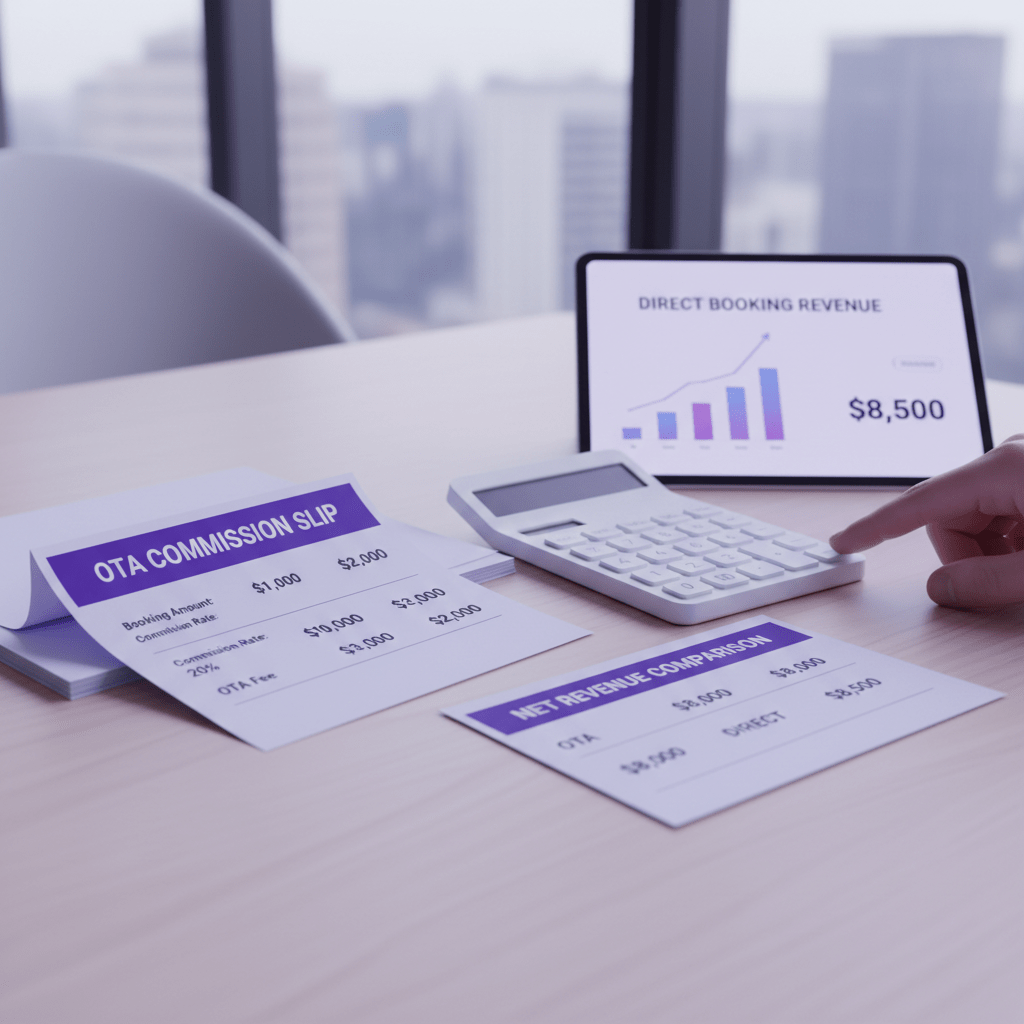
Tired of Paying High OTA Commissions? There’s a Better Way
Ever looked at your monthly OTA bill and felt your stomach drop? Yeah, that little moment hurts. A room sold for $200 can hand over $40 in commission at a 20% rate, and that adds up fast for busy hotels. Some hotels are losing thousands each month just to stay visible on big booking sites.
That’s why more hotels are looking at google hotel ads as a smarter path to increase direct bookings. Instead of sending every guest through an OTA, you can show up right inside Google search results, Google Maps, and Google Travel, where people are already looking for a place to stay. It puts your hotel side by side with those big OTA brands, but with more control over the booking path.
And here’s the cool part: Google has a huge share of search traffic, so hotel advertising on Google can catch travelers at the exact moment they’re ready to book. Plus, there’s more than one way to show up there. Paid placements, free booking links, and metasearch advertising all play a part.
In this guide, we’ll break down how google hotel ads work, what google hotel ads pricing can look like, the difference between paid ads and google free booking links hotels, and how to get set up without making the usual launch mistakes. If you’ve been stuck leaning too hard on OTAs, this is your way out… or at least your way to a much better split.

1. What Are Google Hotel Ads? A Visual Deep Dive
You know that moment when someone is ready to book, but they’re still comparing a few tabs? That’s the sweet spot. And that’s exactly where google hotel ads show up.
Google Hotel Ads are dynamic listings that show your hotel’s price, room info, and availability right inside Google Search, Google Maps, and Google Travel. So instead of just a plain text ad, travelers can see your rates next to other options in the same screen. Pretty handy, right?
Here’s the easiest way to picture it:
| Where it appears | What travelers see | Why it matters |
|---|---|---|
| Google Search | Hotel Pack with prices, photos, and booking options | Puts your property near the top when intent is high |
| Google Maps | Rates and hotel details on map results | Great for last-minute and local searches |
| Google Travel | Side-by-side hotel rate comparisons | Helps you compete with OTAs in one glance |
These ads are different from regular search ads. A text ad might say, “Book Your Stay Here.” Google Hotel Ads show the actual room rate and booking path, which feels a lot more useful for someone who’s already close to booking.
And there’s another piece people miss: google free booking links hotels. These are unpaid listings that can appear in the same hotel pack. Paid google travel ads give you more reach and control, while free links give you baseline visibility without paying for every click. Honestly, the best setups use both. One gives you extra push, the other gives you a steady floor.
If you’ve been relying only on OTAs, this is a nice shift. Google can help you get in front of guests earlier, keep more of the booking value, and increase direct bookings without making every reservation go through a middleman.
2. Google Hotel Ads vs. OTAs: Reclaiming Customer Ownership and Profit
You know that sinking feeling when a booking comes in, but you still don’t really know the guest? Yep. That’s the tradeoff with OTAs.
With OTAs, you get the reservation, but they usually keep the guest relationship. The traveler books on their site, the data stays there, and your hotel ends up paying a fee that can land in the 15% to 30% range, with many hotels seeing 15% to 25% per booking, depending on the platform and deal mix. A $200 room at a 20% commission means $40 gone. Do that all month and ouch. Recent hotel commission estimates from Cloudbeds show how fast those fees stack up.
Google Hotel Ads works differently. You’re not just renting space on someone else’s shelf. You bid for visibility, then send the guest to your own booking engine. That means the stay is booked on your site, so you can keep the customer data for follow-up emails, loyalty offers, upsells, and repeat stays. That’s the real win. Not just the booking. The relationship.
Here’s the basic money picture:
| Channel | How you pay | What you keep |
|---|---|---|
| OTA | Fixed commission per booking | Less guest data, less brand control |
| Google Hotel Ads | CPC, CPC%, or target CPA | Booking lands on your site, plus guest data |
| Direct site booking | Mostly your own marketing cost | Full brand control and customer ownership |
And brand control matters more than people think. On your own site, you choose the photos, the room bundles, the breakfast add-ons, the late checkout upsell, all of it. On an OTA listing, your hotel sits in a neat little box next to ten others. Same room type, same star rating, same race to the bottom. Kind of tiring, honestly.
Google Hotel Ads also gives you more room to test. Maybe you want to push weekend stays. Maybe you want to fill Tuesday and Wednesday nights. Maybe you want to offer a spa package for couples. On your site, that stuff is easy to show. On an OTA, not so much.
So yes, OTAs still help with reach. But if your goal is to increase direct bookings and keep more profit in-house, Google Hotel Ads is the better long game. And for hotels using tools like Ease My Hotel, that direct booking flow can plug into one dashboard, so your team isn’t bouncing between systems just to track one guest from search to stay.
Actually, wait. That’s the part people miss most. It’s not only about lower google hotel ads commission pressure. It’s about owning the guest from the start.

Try Ease My Hotel for free.
No lock-in contracts. Cancel anytime
3. How Google Hotel Ads Work: The Engine Behind the Ad
Ever wonder why one hotel shows up with a price, a map pin, and a big blue book button, while another just… vanishes? That’s the machine at work.
And the good news is, it’s not magic. It’s just a few moving parts talking to each other.
At the center is a Hotel Ads campaign inside your Google Ads account. That campaign is what tells Google, “Hey, show my property to travelers who are looking right now.” From there, Google pulls in your hotel data and matches it to search moments that matter, like someone typing “beach hotel in Miami tonight” or checking prices on Google Travel.
Here’s the basic flow:
- You create a Hotel Ads campaign in Google Ads.
- Your partner sends hotel data to Google.
- Google shows your rates, room info, and booking link.
- The traveler clicks through and books on your site.
Simple enough on paper. In real life, there are a few feeds behind the curtain.
| Feed type | What it sends | Why it matters |
|---|---|---|
| Hotel List Feed | Property name, address, and basic hotel info | Helps Google know which hotel is which |
| Price Feed | Live room rates and availability | Keeps your prices current in search results |
| Point of Sale Feed | Booking page URLs and landing page details | Sends guests to the right page to finish booking |
Those feeds work together like a little relay team. If one is off, the whole thing can wobble. A wrong rate. A missing room type. A bad landing page. And then your ad might not show the way you want.
Now, here’s the part that trips people up: hotels do not usually connect to Google directly. They connect through a Google Integration Partner. That might be your booking engine, PMS, or channel manager, as long as it’s an approved partner. Google has a big partner network, with over 200 certified options, and that matters because the partner handles the data sync and setup for you. You can see Google’s partner list on its hotel connectivity page.
So if you’re using a system like Ease My Hotel, that’s where things get smoother. Your booking management, OTA sync, and hotel dashboard can all help feed the right data into Google without a bunch of manual copying and pasting. And honestly, that saves a ton of headaches.
The usual setup looks like this:
- Your property gets matched to your Google Business Profile
- Your rates and availability sync in real time
- Your ads are tied to the right landing pages
- Travelers click and book on your direct site
But wait, there’s one more thing. The ad only works well if the data stays clean. Bad launch setups happen all the time. Mismatched rates. Unclaimed profiles. Non-certified tools. No conversion tracking. Weird pricing gaps versus OTAs. All of that can slow things down or make the campaign cost more than it should.
So the best move is pretty boring, but it works: start with clean data, a certified partner, and a direct booking path that’s easy to trust. Once that’s in place, google hotel ads can do what they’re supposed to do. Put your hotel in front of ready-to-book guests, then send them straight to you.
And that’s the real point, right? Less mess. More control. More direct bookings.
4. The Business Case: 3 Data-Backed Reasons to Invest in Hotel Ads
You know that moment when a booking lands and you think, “Nice”… then you remember the OTA took a big slice? Yeah. That feeling is exactly why google hotel ads keeps getting attention.
Here’s the deal. If you want to increase direct bookings, you need a channel that puts your hotel in front of people who are already close to booking. Not just browsing. Not daydreaming about a trip six months from now. Right there at the finish line.
1) You keep more money in-house
OTA fees usually run from 15% to 30% per booking, and that can sting fast on a busy calendar. A $200 room at a 20% commission means $40 gone. That’s before you even think about repeat stays or upsells. Industry guides also point out that direct booking costs can sit around 2% to 3%, which is a much nicer place to be for your bottom line. Ease My Hotel OTA commission guide shows how quickly those fees pile up.
| Channel | Cost style | What you keep |
|---|---|---|
| OTA booking | 15% to 30% commission | Less margin, less guest data |
| Google Hotel Ads | CPC, CPC%, or target CPA | Direct booking path and guest ownership |
| Direct website booking | Your own marketing spend | Full control of the guest journey |
2) Small hotels can stand next to big brands
This part is pretty cool. Google Hotel Ads gives independent hotels and smaller chains a chance to show up beside global names in google hotel search and Google Travel. So you are not stuck shouting into the void while the big guys take all the clicks. You get a fair shot if your rate, photos, and booking path look strong.
And that matters for hotel advertising on Google. A clean listing, a good rate, and a simple booking flow can help a 24-room inn in Asheville compete with a giant chain in the same market. Weird? A little. Useful? Very.
3) These travelers are ready now
People clicking hotel metasearch advertising are usually not casual window shoppers. They are comparing dates, rates, and room options right before they book. So the intent is high. Really high.
Google Hotel Ads also plays well with the billboard effect. Guests may see you in search, then come back later to book direct. That means the ad can help create demand even when the final booking happens somewhere else. Plus, sponsored Google Hotel Ads have been tied to stronger booking lift in case studies, which is why many hotels keep testing and refining them.
If you’re using a system like Ease My Hotel, this gets easier to manage because your booking data, OTA sync, and guest flow can live in one place. Less mess. Fewer dropped leads. More direct bookings. That’s the goal, right?
But wait, here’s the part most hotels miss: google hotel ads pricing is not just about the bid. It’s about the whole path from search to stay. If your rates are off, your profile is weak, or your booking engine feels clunky, you’ll pay for clicks without getting the payoff.
So the business case is pretty simple. Keep more margin. Show up beside bigger names. Catch travelers who are already ready to book.
5. Getting Started: Your 4-Step Google Hotel Ads Action Plan
You know that feeling when a new tool looks simple… and then you open it and think, oh no. Yeah. This part can feel like that at first.
But here’s the good news. If we break google hotel ads into small steps, it gets a lot easier. And if you’re using a system like Ease My Hotel, you already have a big leg up because your booking data, OTA sync, and guest info can live in one place instead of ten.
Step 1: Audit your tech stack
Start with your booking engine, PMS, or channel manager. Is it a certified Google Integration Partner? That’s the first question. Not the second. The first.
Google has a partner list with over 200 certified options, and approved systems help push your hotel data into Google the right way. If your setup is not certified, you can run into broken feeds, bad matches, or ads that just don’t show up.
Step 2: Clean up your Google Business Profile
Your Google Business Profile is the base layer. If the name, address, phone number, photos, amenities, or hours are wrong, Hotel Ads can pull in messy info. And messy info leads to messy bookings.
Make sure your profile matches your website. Use clear room photos. Add parking, Wi-Fi, pet policy, and check-in times. Little things matter here.
Step 3: Connect your feeds and pick a bidding style
Now work with your partner to connect the data feeds. That usually means live rates, room availability, and booking links. Once that’s flowing, pick a bidding strategy that fits your comfort level.
For beginners, a simple Manual CPC or CPC% setup usually feels easier to handle at first. If you want a lower-risk start, some hotels test commission-style models where available, since you pay based on results instead of just clicks. But the main thing is this: don’t guess. Start small, watch the numbers, then adjust.
Step 4: Launch, watch, and tweak
This is not a set-it-and-forget-it channel. Honestly, nothing good in hotel marketing really is.
Check these numbers each week:
| Metric | What it tells you |
|---|---|
| Impressions | How often your hotel is seen |
| Click-through rate | Whether travelers like what they see |
| Conversions | How many clicks turn into bookings |
| Cost | What you’re spending to get traffic |
| ROAS | Whether the spend is paying back |
And here’s a smart habit: compare your direct booking rate against your OTA flow. If you see more traffic but weak bookings, the problem may be your landing page, rate parity, or room offer. Not the ad itself.
A recent guide from Cloudbeds on OTA commissions shows why so many hotels are shifting budget toward direct channels. OTA fees can run from 15% to 30%, while direct booking costs are usually much lower. So yes, the ad setup takes work. But the payoff can be a lot better than handing over a chunk of every stay.
If you want one simple rule to follow, use this: clean data first, then launch, then review often. That’s how google hotel ads turns from “another ad thing” into a real way to increase direct bookings.
And if your team is tired of bouncing between systems, a centralized platform like Ease My Hotel can help keep the whole process from feeling like chaos with a login screen.
Take Control of Your Hotel’s Digital Front Door
You know that moment when a guest is ready to book, but one more tab gets opened? That tiny pause is where money gets won or lost. And for hotels, that pause now lives inside google hotel ads.
This is not a nice extra anymore. It’s a core part of a smart direct booking plan. Google Hotel Ads helps you show up in google hotel search, Google Maps, and Google Travel, so travelers can see your rates and book straight from your site. That means less OTA dependency, better profit, and more control over the guest relationship.
The math is hard to ignore. OTA commissions often land around 15% to 30%, which means more of each stay slips away before the guest even arrives. With Google Hotel Ads, you keep the booking path closer to home. Plus, google free booking links hotels can give you extra visibility without paying for every click.
If you want the practical next step, keep it simple: contact your booking engine or PMS provider today and ask one question: How can you help us get started with Google Hotel Ads?
Try Ease My Hotel for free.
No lock-in contracts. Cancel anytime