
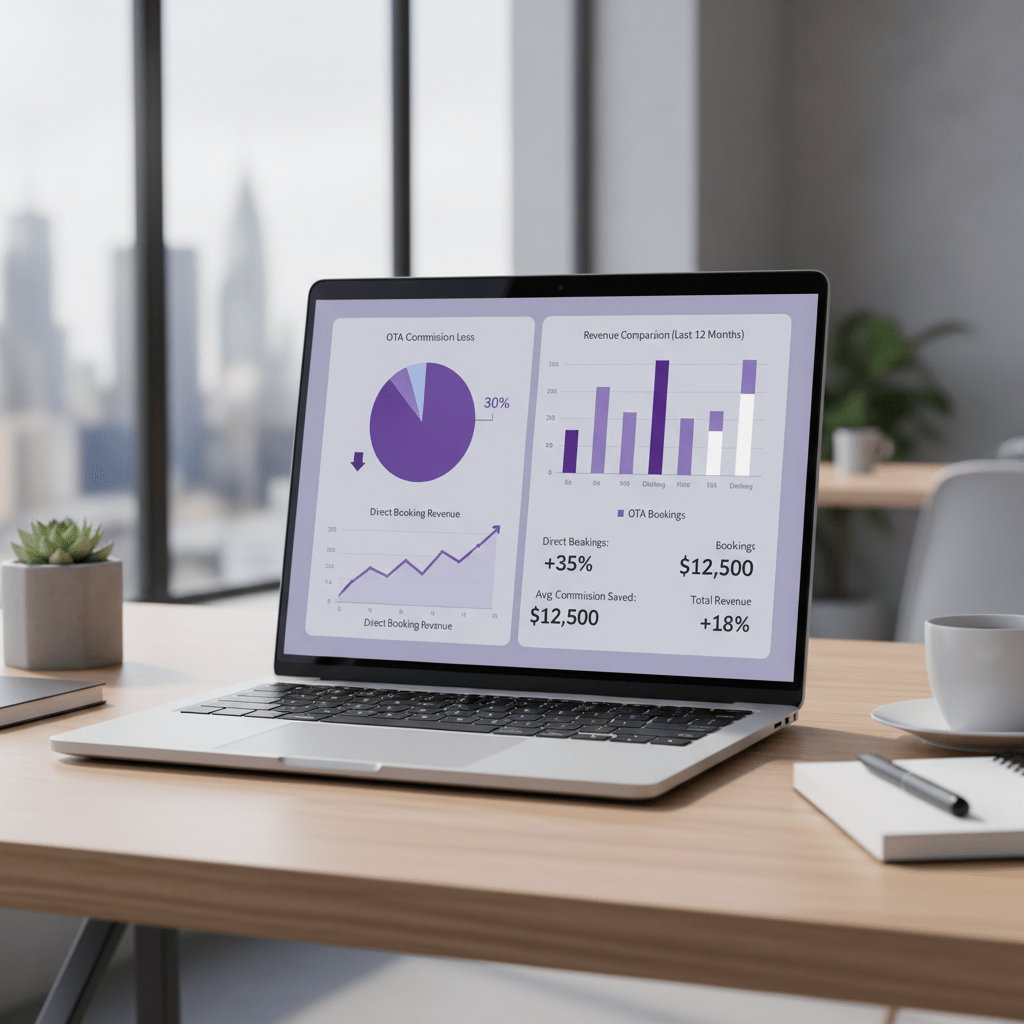
Breaking Free from OTAs: Why PPC Is Your Key to Profitable, Direct Bookings
Ever look at a booking report and think, “Wait… where did the money go?” A lot of hotel owners feel that sting. OTAs can fill rooms, sure. But they also take a bite out of every stay, and that bite is usually around 15% to 30% per booking. For a $600 room night, that can mean $120 gone before you even pay staff, clean the room, or pour the welcome coffee.
That’s why digital marketing for hotels has gotten so much more hands-on. Pay-Per-Click ads give you a way to speak directly to travelers who are already searching. No middleman. No big commission cut. Just your hotel, your offer, and a better shot at increase direct bookings.
PPC is also fast. SEO can take months, while PPC can start bringing traffic in days. And for hotels, that speed matters. People shop, compare, and book fast, so your hotel PPC strategy needs to show up at the right moment.
And honestly, that’s the good part. You get more control. More guest data. More room to grow your hotel marketing plan without giving away so much of each sale.
In this guide, we’ll walk through Google Ads for hotels, metasearch advertising for hotels, remarketing, keyword tips, and the simple math behind measuring hotel marketing ROI. So let’s get into it.

Understanding the Power of PPC in Your Hotel’s Digital Marketing Mix
Picture this. A traveler is on their phone at 11:47 p.m., searching for a room near your hotel. They’re not browsing for fun. They want to book now. That’s where PPC steps in.
PPC, or pay-per-click, means you pay to show ads to people who are already looking for a stay. Think Google Ads for hotels, Facebook ads, and even metasearch advertising for hotels. You’re not shouting into the crowd. You’re showing up right in front of guests who already have travel on their mind.
And that’s a pretty big deal.
SEO is more like planting seeds. It helps over time, but it usually takes months to really pay off. Email marketing is great too, but it works best after someone already knows you. PPC sits in the middle of your digital marketing for hotels plan and brings fast traffic from people ready to book. In travel, speed matters. A lot.
Here’s the thing though. The real win is not just clicks. It’s owning the guest relationship from the first visit. When someone books direct, you get their data. That opens the door to upsells, repeat stays, and remarketing later. With OTAs, you lose a lot of that control, and those commission fees can take about 15% to 30% of each booking, according to OTA commission rate guides.
So if your hotel marketing plan feels a little stuck, PPC can give it a push. Fast traffic. Better control. More chances to increase direct bookings. And yes, it pairs nicely with tools like Ease My Hotel, which helps hotels keep bookings, guest messages, and operations in one place. Nice and tidy. No chaos. Well, less chaos.
| Channel | Best for | Speed |
|---|---|---|
| PPC | Immediate traffic and direct bookings | Days |
| SEO | Long-term search growth | Months |
| Guest retention and repeat stays | After first stay |
And once PPC starts working, you can test new offers, room types, and rate messages without waiting around forever. That flexibility matters more than people think.
The Foundation: Pre-Campaign Essentials for PPC Success
Before we spend a single dollar on ads, we need to talk about the landing spot. Because this part? It makes or breaks the whole thing.
If your hotel website loads slowly, feels clunky on mobile, or hides the booking button like it’s playing hide-and-seek, PPC traffic will leak away fast. Travel booking pages already see abandonment rates around 81.7% to 84.63%, so a rough booking flow can burn through ad spend in a hurry hotel booking abandonment data. That means your website and booking engine need to work together like a good front desk team. Calm. Clear. Fast.
And yes, I’ve seen this happen. Great ad. Great offer. Terrible checkout. Oof.
A simple hotel PPC strategy starts with three things:
| Pre-campaign piece | What to check |
|---|---|
| Website | Fast load time, clear room info, mobile-friendly pages |
| Booking engine | Easy dates, clear rates, simple payment steps |
| Tracking | Bookings, calls, form fills, and revenue data |
Now, let’s talk about the guest. Not every traveler wants the same thing. A business traveler near the airport wants speed and Wi‑Fi. A luxury couple wants views, late checkout, and maybe spa access. A family on a budget cares more about pool time and parking. So build a guest avatar before you build the ads. It helps your hotel advertising campaigns stay focused instead of noisy.
Try this quick fill-in:
- Business traveler: needs fast booking, breakfast, parking
- Luxury couple: wants romance, upgrades, and quiet rooms
- Family traveler: needs space, pool, and fair pricing
- Weekend explorer: wants location, deals, and easy access to attractions
Actually, wait. There’s one more piece people skip. Keywords.
Start with brand terms first, like “grand hyatt chicago.” Then add location searches, like “hotel near navy pier.” After that, layer in amenity terms such as “chicago hotel with indoor pool” or “hotel with free parking downtown.” These are the kinds of searches that often lead to real bookings, not just random clicks.
If you’re using Google Ads for hotels, this is also where negative keywords matter. Words like jobs, careers, salary, free, blog, and images can pull in the wrong crowd. That’s wasted spend. Nobody wants that.
And if you’re trying to keep bookings, guest messages, and daily ops in one place, a tool like Ease My Hotel can help you stay organized once those direct bookings start coming in. Cleaner operations. Better follow-up. Less mess.
So before launch, check your site, build your guest avatar, and map your keywords. Small steps. Big difference.

Try Ease My Hotel for free.
No lock-in contracts. Cancel anytime
Mastering Google Ads: Your Primary Tool for Capturing Intent
You know that moment when someone is already halfway to booking? That’s the sweet spot.
With Google Ads for hotels, we can catch travelers right when they’re searching for a room, a location, or a perk. Search campaigns are the workhorse here. You bid on high-intent keywords like “hotel near airport,” “boutique hotel in Chicago,” or “hotel with free parking.” Those searches usually mean one thing: the guest is close to booking.
And here’s the part a lot of hotels skip. Bid on your own brand name. Yes, your own name. If you don’t, an OTA might show up right above you and grab the click you should have owned. That’s a painful little handoff, especially since OTA commissions can take about 15% to 30% of a booking value, according to OTA commission rate guides.
A good search ad should sound simple and helpful. Not flashy. Just clear.
| Search ad piece | What to say |
|---|---|
| Headline | Hotel name, location, and a key perk |
| Description | Direct booking offer, free Wi-Fi, parking, breakfast |
| Sitelinks | Rooms, offers, map, contact |
| Callout | Best rate, flexible cancel, book direct |
Example: “Book Direct at Lakeview Hotel | Near Navy Pier | Free Breakfast.”
That kind of copy works because it answers the traveler’s question fast.
But search is only one part of the mix.
Display ads and remarketing help you stay in front of people after they leave your site. Maybe they checked rates and got distracted by a text. Maybe they looked at your pool photos and then wandered off to compare options. Happens all the time. Display ads can show across other sites with nice visuals, while remarketing nudges past visitors back to your booking page. A few good audience buckets are:
- All site visitors from the last 30 days
- People who viewed room pages
- Booking engine abandoners from the last 7 days
- Brand searchers who did not book
- Past guests who may come back again
I like remarketing because it feels polite. Not pushy. Just a reminder.
Now, there’s also Performance Max for Travel Goals. It’s Google’s newer automated campaign type, and it can run across Search, Display, YouTube, Gmail, and more. You give it your goal, your creative, and your conversion data, and it looks for guests who are more likely to book. Think of it like a smart assistant that keeps testing where your ads should show. It can save time, but only if your tracking is clean and your offers are clear. Messy setup in, messy results out. Pretty much every time.
The best hotel PPC strategy usually mixes all three: search for intent, display for awareness, and remarketing for the second chance. That combo gives your hotel advertising campaigns a better shot at increase direct bookings while keeping control in your hands. And if you want to keep bookings, guest messages, and day-to-day ops in one place, Ease My Hotel can help once those direct reservations start rolling in. Less tab switching. Less chaos. More breathing room.
Expanding Your Reach: Metasearch and Social Media PPC
You know that moment when a traveler is comparing five tabs at once? Yeah, that. Metasearch and social ads can catch them before they drift away.
First up, metasearch advertising for hotels. Google Hotel Ads and TripAdvisor are not OTAs. They’re price comparison spots. Big difference. The guest is still shopping, but now your direct booking link can sit right beside the big booking sites. If your rate is sharp and your offer is clear, you’ve got a real shot at keeping that booking in-house. And that matters, since OTA commissions can still eat around 15% to 30% of each reservation, based on OTA commission rate guides.
A lot of hotels miss this part. They show up on metasearch, but the direct price is worse than the OTA price. Oof. That’s like handing the guest a map and then pointing them to your competitor.
| Metasearch move | What to do |
|---|---|
| Google Hotel Ads | Show your direct rate clearly |
| TripAdvisor | Keep pricing competitive |
| Direct link | Send guests straight to booking |
| Offer | Match or beat OTA value |
Now for social media PPC. Facebook ads and Instagram ads are great for people who aren’t ready to book yet. That’s the top of the funnel. Short video ads work well here. Show the lobby, the pool, the breakfast spread, the sunset view. Real stuff. The kind of thing people can picture themselves in.
Then there’s the middle of the funnel. Carousel ads are nice for this because you can show a few room types in one swipe. One card for a king room. One for a suite. One for a family setup. Nice and simple. OK, maybe not glamorous, but it works.
Social media also gives you some fun targeting choices. You can reach people based on interests like luxury travel, behaviors like frequent travelers, or life events like anniversary planning. That last one can be gold for romantic stays. And no, you don’t need to guess. The platform already has the signals.
Here’s a simple way to think about it:
- Metasearch helps capture ready-to-book guests
- Facebook and Instagram help build interest
- Video ads show the guest experience
- Carousel ads help people compare rooms
- Targeting helps you reach the right crowd
I like to think of it like this. Google Ads for hotels grabs the person who’s already asking, “Where should I stay?” Metasearch shows them where to book. Social ads help them remember why your place looked so good in the first place.
And when you start getting those direct bookings, a tool like Ease My Hotel can help keep the whole thing tidy. Booking management, guest communication, and your day-to-day ops all in one place. Less scrambling. More control. Better follow-through.
So if your hotel marketing plan feels a little one-note, this is the next move. Use metasearch to stay in the race. Use social to build interest. And keep pushing toward more direct bookings, not just clicks.

Budgeting and Measuring the ROI of Your Hotel Advertising Campaigns
You know that moment when the dashboard looks busy, but the money part still feels fuzzy? Yeah, that part trips up a lot of hotel teams.
Let’s make it simpler. A PPC budget for digital marketing for hotels can be set in two pretty normal ways. Some hotels use a slice of room revenue, like 3% to 8% of monthly direct booking revenue. Others start with a target cost per acquisition, or CPA, and work backward from there. If a direct booking is worth $600, and you want a $100 CPA, then you know the ad spend has to stay below that line.
That’s the part people skip. And then they wonder why the numbers feel off.
A good starting point is this:
| Budget method | How it works | Good for |
|---|---|---|
| Revenue percent | Set aside part of room revenue for ads | Stable properties with steady demand |
| Target CPA | Set a max cost for each direct booking | Hotels focused on profit per booking |
| Test budget | Start small, then raise spend on winning ads | New campaigns or seasonal pushes |
Now for the KPI list. Keep it short and honest.
- ROAS, or return on ad spend, tells you how much booking value comes back for each ad dollar.
- Cost per booking shows what you paid to get one reservation.
- Booking value helps you see which campaigns bring in bigger stays.
- Occupancy rate contribution shows if your hotel advertising campaigns are filling rooms that would’ve stayed empty.
For hotel PPC strategy, many teams aim for about a 3:1 to 4.5:1 ROAS, with stronger campaigns going higher when the room mix and dates line up well hotel PPC ROAS benchmarks. But here’s the trick. ROAS by itself can lie a little. A $90 ad cost on a $600 booking looks fine, but the real win shows up when you compare that to OTA commission.
Let’s say the OTA would have taken 20% of that $600 booking. That’s $120 gone. If PPC brought in the same booking for $90, you saved $30 right there. And you kept the guest data. That means more room for remarketing, repeat stays, and better guest follow-up later.
That’s true ROI. Not just cheap clicks.
Track it in Google Analytics and your booking engine. Watch source, booking value, conversion rate, and abandoned checkout steps. A clean setup makes measuring hotel marketing ROI a lot less painful. And if your team wants booking management, guest messages, and day-to-day operations in one place, Ease My Hotel can help keep the whole picture tidy. Less guessing. More control.
One last thing. Check your negative keywords too. Jobs, careers, salary, free, blog, and images can drain spend fast. Tiny fix. Big difference.
5 Common PPC Mistakes Hotels Make (And How to Avoid Them)
You know that sinking feeling when an ad gets clicks but no bookings? Yeah. That hurts. And for hotels, it usually means money is slipping through the cracks.
Here are 5 PPC mistakes I see a lot in digital marketing for hotels, plus a simple fix for each one.
1) Not bidding on your own brand name
This one is wild, but it happens all the time. If you skip your brand terms, OTAs can grab that easy, high-intent traffic instead. A traveler searching your hotel already knows you. They’re not window shopping. They’re looking for you.
And because OTA commissions often sit around 15% to 30% per booking, that mistake can get pricey fast OTA commission rate guides.
Fix: Always protect your brand name in Google Ads for hotels. It’s usually one of the cheapest clicks you’ll get.
2) Sending ad traffic to the homepage
I get why teams do this. It feels easy. But easy is not always smart.
If someone clicks an ad for “hotel deals,” send them to the specials page. If they click “hotel with parking,” send them to a page that shows parking right away. Don’t make people hunt around like they’re solving a puzzle.
Fix: Match the ad to the landing page. One message. One page. Less friction.
3) Ignoring negative keywords
This one drains budget in a sneaky way. Terms like jobs, careers, salary, free, blog, and images can pull in people who will never book.
And no, they’re not “sort of interested.” They’re just browsing.
Fix: Build a strong negative keyword list before launch. Then check search terms every week.
4) Poor geotargeting
If your hotel gets most of its bookings from Chicago, why spend money showing ads to people in places that never convert? Makes no sense, right?
A lot of hotel PPC strategy problems start here. The targeting is too wide, so spend goes out to weak markets.
Fix: Focus on your real source markets first. Then test new cities or regions later, one at a time.
5) Having uncompetitive pricing
This one’s a tough pill. You can run great hotel advertising campaigns, but if your direct rate looks worse than an OTA rate, guests will click away.
They’ll compare. They always do.
And if a $600 room gets hit with a 20% OTA commission, that’s $120 gone on one booking. So if your PPC campaign brings in that same stay for less, you’re ahead. If not, you’re basically paying to send traffic to someone else.
Fix: Check your rate parity often. Keep direct booking value clear with perks like breakfast, parking, or flexible cancel rules.
| Mistake | What it costs you | Simple fix |
|---|---|---|
| No brand bidding | Lost easy clicks to OTAs | Bid on your hotel name |
| Homepage traffic | Weak conversion rate | Send guests to the right page |
| No negative keywords | Wasted ad spend | Block bad search terms |
| Bad geotargeting | Low-quality traffic | Target real source markets |
| Bad pricing | Guests book elsewhere | Match or beat OTA value |
The good news? These are all fixable. Small changes can make a big difference in measuring hotel marketing ROI and helping you increase direct bookings.
If you want more control once those bookings come in, Ease My Hotel can help keep booking management, guest messages, and daily ops in one place. Less mess. More time back.
Take Control of Your Bookings and Build a More Profitable Future
You know that nice feeling when a booking comes in direct? No middleman. No extra cut taken out first. Just your hotel, your guest, and a cleaner path to profit.
That’s the big idea here. Build the base right. Keep your website easy to use on mobile. Run Google Ads for hotels with your own brand name in the mix. Use metasearch advertising for hotels to stay in the comparison game. And keep an eye on ROI so you know what’s working and what’s just eating budget.
PPC is not just another bill. It’s a way to buy more control.
And that matters a lot when OTAs can take about 15% to 30% of each booking, while direct bookings let you keep more of the sale and the guest data too. That data helps with remarketing, repeat stays, and better offers later. Nice little chain reaction.
So start small this week. Audit your booking engine on a phone. Make sure the path to book is quick, clear, and not full of weird little roadblocks. Then begin bidding on your own brand name so you stop handing easy clicks to someone else.
If you want to keep bookings, guest messages, and daily operations in one place, Ease My Hotel can help make that part simpler too. Less chaos. More control. Better odds of growing on your own terms.
Try Ease My Hotel for free.
No lock-in contracts. Cancel anytime