

Why Every Cent Counts: The Unseen Impact of Billing Errors on Your Hotel’s Bottom Line
It’s 7:40 on a Sunday morning. A guest stands at your front desk with a printed folio in one hand and a coffee in the other. “I never ordered room service,” he says. “And why am I paying for parking twice?”
You know that sinking feeling. The line behind him is growing. Your one staff member on shift is flipping between screens, trying to figure out who typed what, and when. Ten minutes later, you knock $38 off the bill just to move things along. Everyone leaves annoyed.
Sound familiar?
That one small fix looks harmless. But add it up over a year and it’s not small at all.
What a Billing Slip Really Costs You
The disputed amount is only the start. Phacet’s analysis puts it well: “An invoice error carries two separate costs: the rework a finance team can see, and the overpayment that leaves without anyone noticing.” Think staff hours spent digging through folios, refunds you didn’t plan for, and charges that never got posted at all.
Here’s how these hotel billing errors hit the things you care about most:
- Cash flow: Missed charges, chargebacks and late OTA payments make your income bumpy and hard to predict.
- Profit: Bones Hospitality Solutions estimates that billing errors, settlement gaps and unauthorized voids can shave 1% to 3% of gross revenue. That’s a vendor estimate, not a verified average for small hotels, but even the low end hurts.
- Staff time: Every manual correction pulls someone away from guests.
- Reputation: One hospitality analysis, citing HSMAI data, reports that billing errors show up in 18% to 23% of negative OTA reviews. Treat that range as a reported estimate, not gospel.
Quick reality check: No one has a clean, verified number for how many small hotel guests hit a billing error. But the pattern is clear. Unexpected charges create disputes, and disputes create bad reviews.
What This Guide Will Do for You
I’m not going to pretend there’s a magic fix. There isn’t. But most small hotel accounting problems come from the same handful of habits, and they’re fixable.
So here’s the plan. We’ll walk through the four most common and costly billing mistakes, then look at how better processes and the right technology can stop them before they reach the guest’s folio. Let’s start with the one that sneaks in quietly every single shift.
Mistake #1: The Domino Effect of Manual Data Entry Errors

Picture a tired agent at 11pm, typing a room rate from a spreadsheet into the system. One finger slips. Nobody notices. And that’s where the trouble starts.
Where the Typos Sneak In
Manual entry looks harmless because each mistake is tiny. But there are a lot of places for tiny mistakes to hide:
- A room rate copied wrong from a spreadsheet
- Arrival or departure dates that are off by a day (that’s a whole night added or missing)
- A typo in the folio notes, like a wrong company name or billing address
- A negotiated corporate rate that never got applied
That last one stings. Xquic’s guide to folio billing errors points out that a missing corporate or negotiated rate code can make the public rate post instead, and that can hit every night of the stay.
How One Typo Becomes Five Problems
Say your agent types $142 instead of $124 for a 3-night stay. That’s $54 too much. (Just an example, but it’s a very believable one.) Here’s how it spreads:
| Where it lands | What goes wrong |
|---|---|
| Guest folio | The guest sees the wrong total and disputes it at checkout |
| Shift report | Room revenue doesn’t match the bookings, so someone has to hunt for the gap |
| Refund or adjustment | A manager approves a correction, often by hand |
| Month-end accounting | Revenue and tax numbers are off until someone fixes them |
| OTA commission check | The commission is based on a rate that doesn’t match the booking |
None of those steps feels big. Together they eat hours. Someone has to trace the error back, fix it, and explain it to the guest.
Why Humans Alone Can’t Win This
How often does manual entry go wrong? Nobody has a perfect hotel-only number. But HITEC cites a general benchmark of about 1% for manual data entry. At 50 payment transactions a day, that’s roughly 15 errors a month, or 180 a year. Busy check-ins and room moves can push it higher.
So what’s the fix? Stop retyping things. When a system pulls the rate and dates straight from the reservation record, there’s nothing to miskey. The corporate rate applies on its own. The dates match the booking. A tool like Ease My Hotel’s booking management works this way, with one record feeding the folio.
Typing isn’t the only place money slips away, though. Next up are the extras that never make it onto the bill at all.
Mistake #2: The Ancillary Charge Black Hole: Mismanaging Add-On Revenue
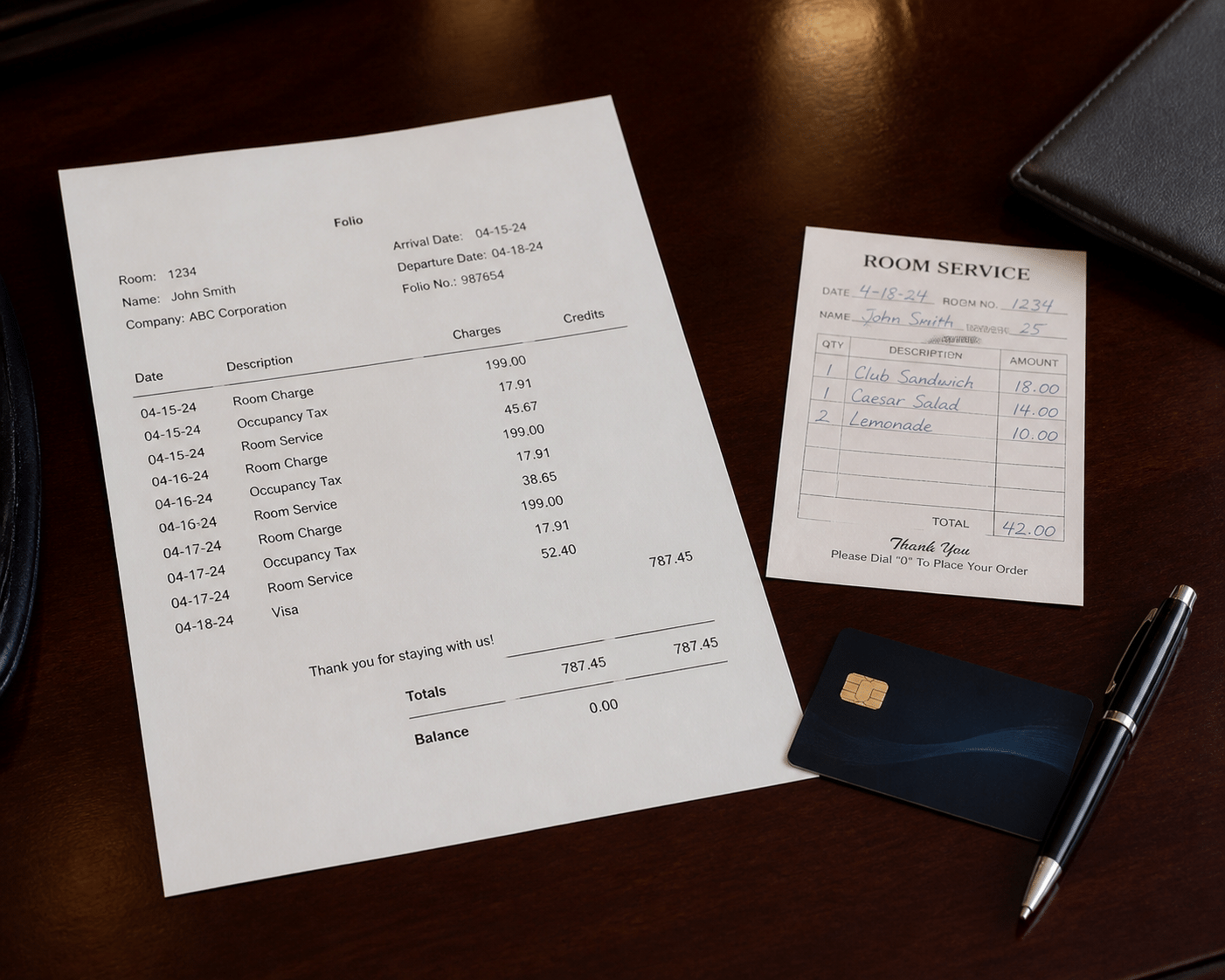
A guest has a late breakfast, a spa massage, and two sodas from the minibar. Four different spots, four different slips of paper. How many of those make it to the folio?
Sometimes all of them. Sometimes none.
Where Add-On Charges Disappear
Most small hotels have more outlets than they realize. There’s the restaurant, the bar, the spa, the gift shop, parking, laundry, and the minibar. Each one has its own way of passing charges to the front desk. A radio call. A handwritten slip. A note stuck to the monitor.
Then the shift gets busy, and the slip ends up in a pocket.
The cost is blunt. Stayntouch’s payment guidance says any charge not posted before checkout can become permanently lost revenue, especially when outlets rely on manual posting. No public study gives a clean percentage for small hotels. But a missed $14 minibar charge is 100% gone. Do that a few times a week and you’ve got a real leak.
Why Late Charges Hurt Twice
Say you catch the missed spa charge two days after checkout. Now what? You email the guest, or you run their card again. Neither feels good.
A charge that shows up after checkout gives the guest no chance to question it while they’re still on your property. They see a strange line on their card statement and think “what is this?” Then they dispute it with the bank, or they leave a review. Maybe both.
That’s the final impression you leave. A great stay, then a surprise bill. Honestly, I’d rather lose the $14.
One Connected System Fixes Most of It
Here’s the thing. Most of this isn’t a people problem. It’s a plumbing problem. When the restaurant register and the front desk system don’t talk to each other, someone has to be the messenger.
A point of sale (POS) system linked to your property management system (PMS) removes the messenger. The server enters the room number, confirms the guest name, and the charge lands on the folio right away. Revfine’s folio guide also recommends staff verify the guest’s name and room number at the point of sale, which catches wrong-room postings before they happen.
Here’s how the two approaches compare:
| Manual process | Integrated POS/PMS | |
|---|---|---|
| How charges travel | Radio calls, paper slips, end-of-shift typing | Instant electronic posting |
| Speed | Hours, sometimes days | Seconds |
| Accuracy | Lost slips, wrong rooms, double entries | Charge matches the room and guest |
| Guest experience | Surprise charges at or after checkout | Folio is current, no surprises |
| Staff effort | Someone chases every outlet | Review exceptions only |
Ease My Hotel’s restaurant management and booking management tools work on this idea, with outlet charges feeding one folio instead of five notebooks.
So you’ve cleaned up typing and add-ons. But the next problem is sneakier, because the numbers can look right and still be wrong. Taxes and fees are up next.
Mistake #3: Navigating the Maze of Taxes, Fees, and Surcharges
A guest looks at her bill and frowns. “What’s a destination fee? Nobody told me about that.” You explain it’s mandatory. She doesn’t hear a word after “mandatory.”
This one gets ugly fast, because it feels like dishonesty to the guest. Even when it’s not.
Too Many Taxes, Too Many Moving Parts
One room night can carry a local tax, a state tax, an occupancy tax, and a tourism levy. Each has its own rate. Some change with the season or the year. Some apply to the room but not to parking or food. Others skip guests who have an approved exemption.
Now picture one tired front desk agent trying to keep all that straight by memory. Weird to expect that, right?
A modern PMS helps here. It can hold rule-based tax profiles by location, charge type, date and guest status, so staff don’t recalculate by hand. But it doesn’t take the legal responsibility off you. Someone still has to check that the rates are current. A quarterly review of your PMS settings, booking engine, channel listings and a few final invoices against government guidance is a smart habit.
When a Fee Feels Like a Trick
Guests don’t hate fees as much as they hate surprises. A resort fee, service charge or parking fee that shows up at checkout is a classic source of guest billing disputes.
The rules are tightening too. The FTC’s rule on unfair or deceptive fees took effect for short-term lodging on May 12, 2025. Hotels must show the total price, including mandatory fees, more prominently than the room-only price. You can still charge the fee. You just can’t hide it. New York City added its own rule in February 2026, and states like California and Minnesota have all-in pricing laws as well.
The Price of Getting It Wrong
A wrong tax rate is a small mistake that repeats on every booking. Underpay and you may face penalties or an audit. Overcharge and you owe refunds and trust. Fee rules can bring civil penalties above $50,000 per violation, according to the research I found, so this isn’t a spot to guess.
Here’s the difference clear itemizing makes:
| Lumped-together folio | Clear, itemized folio |
|---|---|
| Room and fees: $212.00 | Room (2 nights at $160): $320.00 |
| Taxes and other: $41.00 | Destination fee (mandatory, $15/night): $30.00 |
| Total: $253.00 | State sales tax: $22.40 |
| Local occupancy tax: $19.20 | |
| Tourism levy: $6.40 | |
| Total: $398.00 |
(Numbers are just for illustration.) The first one invites a fight. The second one answers questions before the guest asks them.
Fees you can’t see are one thing. Money that never arrives from third parties is another, and it’s next.
Mistake #4: Failing to Reconcile OTA Commissions and Virtual Cards

It’s the 28th of the month. You’ve got a Booking.com statement open in one tab, an Expedia report in another, and your own records in a spreadsheet that’s seen better days. Nothing matches. Of course it doesn’t.
If you sell rooms through more than one online travel agency (OTA), this scene probably feels painfully familiar.
Try Ease My Hotel for free.
No lock-in contracts. Cancel anytime
Why OTA Numbers Rarely Match Your Books
Every OTA reports a booking in its own way. One shows the net rate. Another shows the gross rate plus commission. A third pays you through a virtual credit card (VCC) that’s loaded with one amount on one date. Your own system has to record all of that, and it’s easy for the pieces to drift apart.
Here are the usual reasons the numbers don’t line up:
- The guest leaves early, but the commission is still based on the original booking
- The guest stays longer, and the virtual card is now short
- Taxes, resort fees or currency conversion are counted one way by the OTA and another way by you
- A cancellation never reached the OTA, so you get billed commission on a stay that never happened
- Staff charge the guest’s own card instead of the OTA’s VCC
Hotel Yearbook’s piece on post-stay commission reconciliation covers how changed stay lengths cause this exact kind of mismatch. And a virtual card can expire or get charged outside its activation window. Then your payment just sits there, or fails.
The Month-End Grind (and Why Cash Flow Suffers)
So someone sits down and matches things by hand. Line by line. Coir Consulting’s 2026 report says independent hoteliers spend one to two full workdays a week reconciling between different platforms. That works out to roughly 32 to 64 hours a month. (That covers all platforms, not just OTAs, so treat it as a rough guide.)
I wouldn’t wish that on anyone. And the cost isn’t only time. While you hunt for a missing $60 here and a wrong commission there, money stays stuck. Underpaid cards go unclaimed. Overcharged commissions go unchallenged because nobody has the energy to dispute them.
What Matching Should Look Like
The fix starts with one rule. Stayntouch’s reconciliation workflow guide suggests matching every line by the OTA confirmation number, then checking status, stay dates, final folio, commission and settlement date. A good system does that for you.
Picture a Reconciliation tab in your property management system. It might look like this:
| OTA confirmation | Stay status | Final folio | VCC amount | Commission | Result |
|---|---|---|---|---|---|
| BK-48213 | Checked out | $412.00 | $412.00 | $61.80 | Matched |
| EX-77190 | Left 1 night early | $268.00 | $402.00 | $60.30 | Flagged: commission too high |
| BK-48377 | Extended 1 night | $530.00 | $398.00 | $59.70 | Flagged: card underfunded |
(Made-up numbers, just to show the idea.) Instead of checking everything, you only look at the flagged rows. Ease My Hotel’s OTA and channel manager, together with its booking management tools, aims to keep the reservation, payment and commission details in one place so you’re not stitching them together at month-end.
Once the OTA money is under control, the next question is how all these fixes fit together.
The Solution: How a Unified Hotel Management System Creates Billing Accuracy
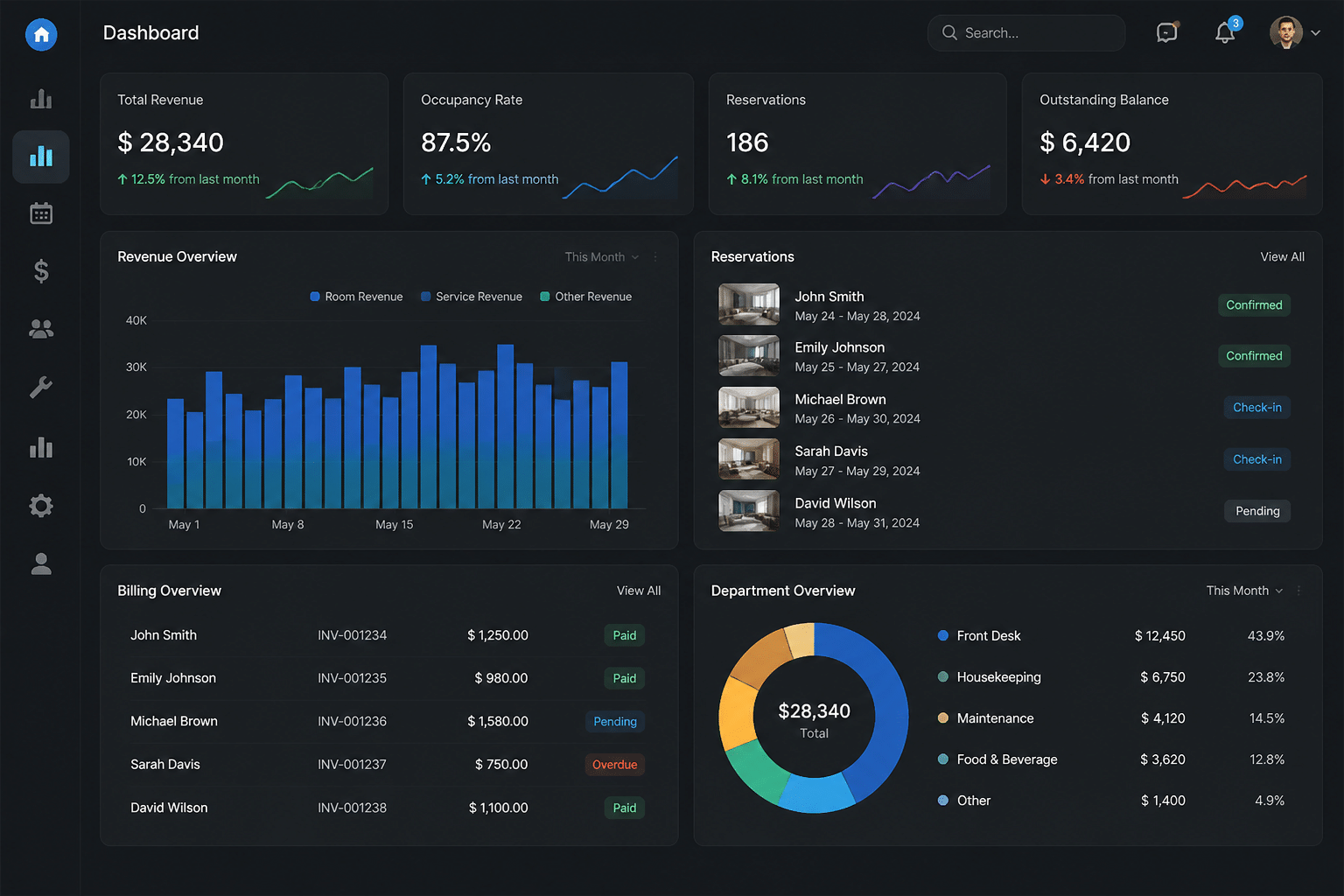
Look back at the four mistakes we just covered. Typos, lost add-ons, tax slips, and OTA mismatches. Different problems, same root. Someone is retyping information, or carrying it from one tool to another.
So the fix isn’t “try harder.” It’s fewer handoffs.
Take the Typing Out of the Picture
A modern property management system (PMS) pulls the rate, dates, and guest details straight from the reservation. Nobody retypes $124 as $142 at 11pm, because nobody types it at all. That’s the whole idea behind automation, and it goes right at the biggest cause of small hotel accounting problems.
There’s some early proof, with a caveat. Worldline says hotels using PMS-driven payment authorization can cut checkout times by up to 50%, with fewer disputes and chargebacks because payment data stays consistent. It estimates costs are recovered in six to nine months. That’s a vendor claim, not an audited average, so test it against your own numbers.
One Record From Booking to Final Invoice
Here’s where it gets good. In a unified system, the booking engine, front desk, restaurant, and invoice all read from the same record. People call this a “single source of truth,” which is a fancy way of saying everyone sees the same numbers.
What that looks like day to day:
- The rate and package a guest saw online are the ones that land on the folio.
- A restaurant or spa charge posts to the room the moment the server confirms the name.
- The corporate rate code applies on its own, for every night.
- Guest details (company name, billing address) get entered once, not three times.
No messenger needed. And no more hunting for the slip that ended up in somebody’s pocket.
Features That Fix the Mistakes We Covered
Not every feature matters equally. These three go straight at the problems above:
- Automated tax engine: Rule-based tax profiles apply the right rates by location, charge type, date, and guest status. It won’t take legal responsibility off you, so keep that quarterly review going.
- Rule-based charge routing: Group and company bills are tricky. The Hotel Blueprint’s ledger guide explains that when routing instructions are entered after charges post, earlier charges can stay on the wrong folio. Set the rules at booking, and room, food, and extras land where they should.
- Integrated channel manager: When reservations, payments, and commissions live together, matching them gets easier. Stripe’s hotel payments guide notes that channel manager and payment links can automate virtual card processing and reconciliation, as long as card data passes through correctly.
Ease My Hotel’s booking management, restaurant management, and OTA and channel manager tools are built around this one-record idea.
Manual Billing vs. Unified PMS Billing
| Task | Manual method | PMS method |
|---|---|---|
| Rate entry | High risk. Retyped from spreadsheets, easy to miss codes | Automated. Pulled from the reservation, applied every night |
| Ancillary charges | Time-consuming. Slips, radio calls, end-of-shift typing | Instant. Posts to the right folio from the POS |
| Tax calculation | High risk. Rates and exemptions kept in someone’s head | Accurate. Rule-based profiles by charge type and date |
| OTA reconciliation | Time-consuming. Line-by-line matching in spreadsheets | Automated. Mismatches flagged for review |
No system fixes everything. Someone still approves refunds and checks exceptions. But that’s a quick review, not a month-end grind.
So what should you actually do first? That’s next.
Securing Your Revenue and Reputation: A 3-Step Plan for Flawless Billing
Let’s zoom out for a second. A typo at 11pm. A spa slip lost in somebody’s pocket. A tax rate nobody updated. An OTA statement that never matches your books. Four mistakes, one shared story: they quietly drain cash and staff hours, and nearly all of them can be prevented.
The good news? You don’t have to fix everything this week. Start here.
Your Billing Action Plan
Step 1: Audit your process. Run the quick self-audit below once a month.
Step 2: Empower your team. Show staff what one small error really costs.
Step 3: Embrace technology. Test whether one connected system can do the retyping for you.
Step 1: Audit Your Process
Pick 10 recent folios and check them against this list:
- Do the room type, dates, rate and package match the original booking?
- Do the guest name and payment method match the reservation?
- Is every deposit posted and taken off the final balance?
- Do restaurant, minibar, parking and spa charges match the PMS?
- Are room taxes, city taxes, fees and exemptions correct?
- Did charges follow the guest after room moves and split folios?
- Does every discount, refund and void have a reason and a manager’s approval?
- Do PMS totals match processor settlements and bank deposits?
- Have you checked unpaid balances, company accounts and virtual cards?
- Is card data protected, with limited staff access?
Don’t be shocked if you find a few leaks. That’s the point.
Step 2: Empower Your Team
People fix what they understand. So tell your staff the real numbers, like the $38 knocked off a bill on a busy Sunday morning, repeated over a year. Teach them to confirm the name and room number before posting, and to flag odd charges mid-stay instead of at checkout. Nobody wants to be the reason for a refund.
Step 3: Embrace Technology
Once you know where the errors start, look at your tools. Could one system pull the rate, post the outlet charges, apply the taxes and flag OTA mismatches? Ask any vendor to demo your own messy scenarios, not just the pretty ones. Ease My Hotel is one option to put on that shortlist.
There’s a bigger payoff too. A 2025 hotel labor-cost report found operators protected their margins by improving labor efficiency, even as wages rose by as much as 5.9%. Fewer manual fixes means more of your revenue reaches profit.
And picture your front desk without the billing detective work. More time to greet people, answer questions and fix real problems. That’s what guests remember.
Ready to see what that could look like? Take a look at Ease My Hotel and start giving your team their time back.
Try Ease My Hotel for free.
No lock-in contracts. Cancel anytime