

Turning Complaints into Opportunities: The New Mindset for Hospitality Success
Here’s a number that should make every hotelier sit up: 56% of customers rarely or never complain after a bad experience. They just leave. No note, no angry call, no second chance.
So if a guest actually speaks up? Honestly, that’s a gift. We just don’t always treat it like one.
Let’s be real. Complaints sting. A guest at the front desk at 11pm, tired and annoyed about a noisy room, can flatten a whole shift’s mood. Your team feels it. The line behind that guest gets longer. Housekeeping gets pulled in, a manager gets paged, and suddenly a normal Tuesday turns into a scramble. I’ve seen good staff dread the phone ringing because of it.
Why a complaint isn’t a threat

But here’s the shift in thinking I’d love you to try. A complaint isn’t an attack. It’s free feedback from someone who still cares enough to tell you what went wrong. Think of it as a little flare going up over a problem you couldn’t see yourself.
Handle it well, and something odd happens. 72.1% of consumers say they’re more likely to use a company again when it fixes a complaint quickly. That’s a broader customer-service number, not hotel-only, but the idea holds up. A fixed problem can build more trust than a stay where nothing went wrong at all.
What you’ll get from this guide
This article gives you a step-by-step plan for how to handle guest complaints effectively, whether you run a 12-room homestay or a busy resort. We’ll look at what poor handling really costs, how to build a service recovery culture, a simple five-step procedure your team can remember, and ways to cover every channel, from the front desk to online reviews.
The goal is simple: protect your online reputation, improve guest satisfaction, and win more repeat bookings. Ready? Let’s start with what’s really at stake.
The Real Cost of Poor Complaint Handling: A Threat to Your Bottom Line
So what happens when a complaint goes sideways? It’s more than one grumpy guest. The damage spreads, and most of it you never see on a report.
Money walking out the door
Start with the obvious loss. An unhappy guest probably won’t book again. In the 2025 State of Customer Experience research from Shep Hyken, 48% of U.S. customers said they were very likely to leave after a poor experience, and another 35% were somewhat likely to. That’s broader than hotels, but you can guess how it plays out at your front desk.
Now think about replacing that guest. One hospitality estimate puts a new booking at about $70 in marketing cost, versus $12 to keep an existing guest. Treat those as rough numbers, since every property is different. Still, losing a repeat guest hurts twice: you lose the stay, then you pay more to find someone new.
When one bad stay becomes a hundred readers
Here’s where it gets ugly. That guest tells friends, and then posts a review. SiteMinder reports that about 70.9% of travelers are influenced by a hotel’s online reputation, and the same source notes that a one-star drop can cut revenue by roughly 5% to 9%. Your market and rating platform change the exact number. The direction doesn’t change.
Lower ratings on TripAdvisor, Google and the OTAs mean fewer clicks, fewer bookings and emptier rooms. And one unanswered review sits there for months.
Here’s how the ripple spreads:
| Step | What happens | What it costs you |
|---|---|---|
| 1. The problem | A noisy room or a dirty bathroom goes unfixed | One upset guest |
| 2. The brush-off | Staff shrug, delay or get defensive | Trust drops fast |
| 3. The exit | The guest leaves quietly and doesn’t return | Lost repeat booking |
| 4. The review | A negative post goes up with no reply | Lower rating |
| 5. The ripple | Future travelers scroll past your listing | Fewer bookings, lower occupancy |
The hidden cost inside your team
There’s a cost nobody puts on a spreadsheet. Staff who deal with angry guests and have no way to fix things get worn down. I’ve watched a front desk agent go quiet for the whole shift after one rough exchange. Morale slips, and tired people make more mistakes.
Managers pay too. Every hour spent on damage control is an hour not spent training, planning or walking the property. You end up firefighting instead of running the place.
The good news? Most of this is avoidable. Let’s look at how to build a team that fixes problems before they snowball.
The Foundation: Fostering a Proactive Service Recovery Culture
A great script won’t save you if your team is scared to use it. Good guest service recovery starts before any complaint shows up. It starts with how you treat your own people.
Give your frontline the power to fix things
Picture a guest telling a housekeeper the air conditioning is broken. If she has to find a supervisor first, the guest waits and gets angrier. Now picture her moving the guest to another room on the spot. Problem gone.
That’s the idea behind the famous Ritz-Carlton policy, where staff can spend up to $2,000 per guest, per incident to make things right (people still debate how it works in real life). You don’t need that number. You need a smaller limit your team can trust, like a free drink, a late checkout, or a meal credit.
Here’s a simple way to show your team when to solve and when to escalate:
| Situation | Who acts | What happens |
|---|---|---|
| Small issue (slow Wi-Fi, missing towels, cold coffee) | Any frontline staff | Fix it now, add a small gesture, log it |
| Medium issue (noise, no hot water, dirty room) | Frontline staff, then supervisor if needed | Move the room or offer a set credit, then follow up |
| Big issue (safety, health, a guest demanding a full refund) | Manager right away | Staff stay calm, explain next steps, hand off warmly |
Train for the hard moments
Empowerment without training is just guessing. Your complaint resolution training doesn’t need to be fancy. It needs to be practiced, ideally with role-play. Cover three things: active listening, calm de-escalation, and your own policies. Mews suggests acting right away, listening calmly, and matching the fix to how bad the problem is.
Key Training Topics for Your Team
- Listening without interrupting
- Repeating the problem back to the guest
- Phrases like “I’m sorry this affected your stay”
- Staying calm with difficult hotel guests
- What each person can offer without approval
- When and how to escalate
- How to log and follow up
Run a 15 minute practice round at your next shift meeting. It feels awkward at first. Do it anyway.
Make it safe to speak up

Here’s the part many hotels skip. Your staff see problems long before guests complain: the lift that sticks, the room 214 shower that never gets hot. If they fear getting blamed, they’ll stay quiet.
So build a no-blame habit. Thank people who flag issues. Keep a shared log of repeat problems, whether that’s a notebook or a tool like Ease My Hotel’s unified dashboard. Then review it weekly and fix the patterns.
This isn’t just a feel-good idea. One Deloitte finding reported by Hospitality Net says 68% of hospitality organizations believe employee well-being links to better customer satisfaction. It’s a perception, not proof. Still, it fits what I’ve seen: happy, trusted teams solve more problems.
With that foundation in place, your team needs one simple routine to follow. Let’s build it next.
The L.E.A.R.N. Framework: A 5-Step Hotel Guest Complaint Handling Procedure
Your team now has the power and the training. What they need next is a routine simple enough to remember at 11pm with a cranky guest in front of them. That’s where L.E.A.R.N. comes in. It’s one of several mnemonic models hotels use for frontline recovery, and I like it because it covers both the talk with the guest and the follow-through behind the scenes.
Here’s the whole hotel guest complaint handling procedure at a glance:
| Step | Letter | What your team does |
|---|---|---|
| 1 | Listen | Let the guest finish. Take notes. |
| 2 | Empathize & Apologize | Say sorry for the experience, in plain words. |
| 3 | Act & Resolve | Offer a real fix, fast. |
| 4 | Record & Notify | Log it and tell the right people. |
| 5 | Nurture & Follow up | Check back and close the loop. |
Steps 1 and 2: Hear them out, then say sorry
Listen. This sounds easy. It isn’t. Don’t interrupt, don’t explain, don’t reach for the policy binder. Let the guest tell the whole story, even the boring parts. Grab a pen and write things down (guests notice that). Then repeat it back: “Let me make sure I have this right.”
Leadership leans on this too. A 2026 account says Bill Marriott Jr. made a habit of asking employees what was working, what was broken and what should change. Same idea, just pointed at guests.
Empathize & Apologize. Say sorry for what the guest went through. You don’t have to admit fault to do that. Try these:
- “I’m sorry this affected your stay.”
- “I understand why that would be frustrating.”
- “Thank you for telling me. I’m looking into this now.”
Avoid “sorry you feel that way.” It sounds like a shrug. Honestly, it’s worse than saying nothing.
Step 3: Fix it while they’re still on property
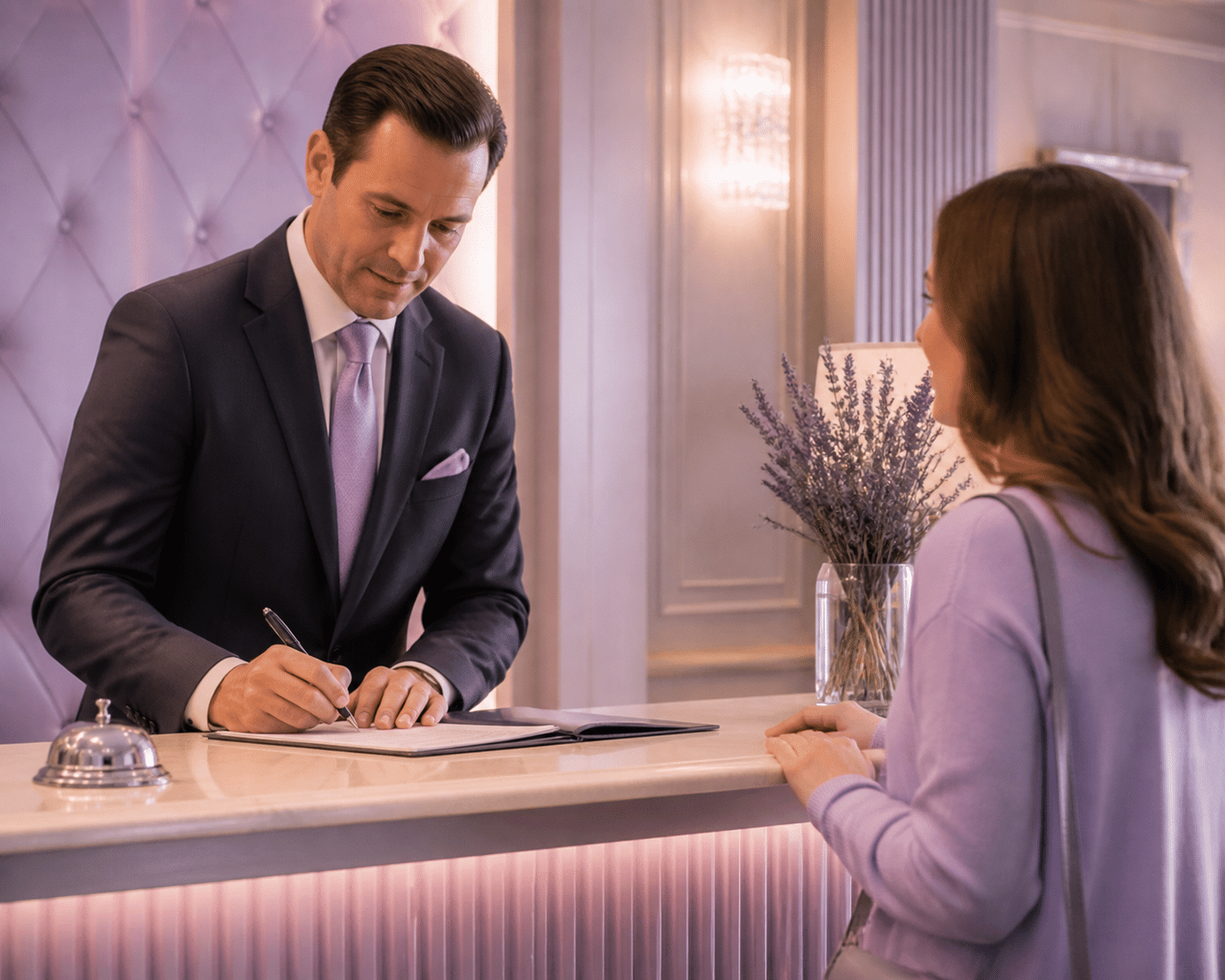
Act & Resolve. Speed matters here. Offer something real, and say it clearly: “Here’s what I can do right now.” Match the fix to the size of the problem. These are common examples, not rules written in stone, so set your own limits:
| Problem size | Example | Who can approve |
|---|---|---|
| Minor inconvenience (cold coffee, slow Wi-Fi, short noise) | Free drink, breakfast, late checkout or loyalty points | Any frontline staff |
| Medium problem (noisy night, no hot water, dirty room) | Room move plus a partial credit, often around 10% to 25% of the night | Frontline, then supervisor |
| Major failure (unusable room, safety or health issue) | Bigger refund or a free night | Manager |
Ask “What would be the most helpful outcome for you?” It’s a little humbling, but it often shows the guest wants less than you feared.
Steps 4 and 5: Write it down, then circle back
Record & Notify. Every complaint gets logged. The tiny ones too. A single broken shower is a repair job. Five broken showers on one floor is a pattern, and you’ll never spot it if the notes live in someone’s head or a sticky pad. Log the room, time, what was promised and who owns it. Then tell housekeeping, engineering or the duty manager so nobody hears the story cold. A shared dashboard, like the one in Ease My Hotel, makes this far easier than juggling notebooks and group chats.
Nurture & Follow up. This is the step most hotels skip. It’s also the one guests remember. Within a few hours, or by the time you promised, check back: “Is the new room working for you?” If yes, great. If not, you’ve caught it before it becomes a one-star review.
That’s the loop. Now let’s look at how to run it when the complaint doesn’t arrive at your front desk.
Try Ease My Hotel for free.
No lock-in contracts. Cancel anytime
Adapting Your Approach: Handling Complaints Across All Channels
The L.E.A.R.N. steps don’t change from place to place. But how you deliver them does. A guest standing at your desk needs something different from a guest typing an angry review at 2am.
Face to face: your body does half the talking
Guests read your face before they hear your words. So uncross your arms, turn toward them and keep your hands visible. Slow your voice down. Soft eye contact helps, staring doesn’t.
If the lobby is busy, try this: “Could we step over here where it’s quieter?” Billing fights, health concerns and noise disputes with another guest should never play out in front of the breakfast crowd. A quiet corner or small office keeps the guest from feeling watched, and it keeps other guests from picking up the mood.
Phone and email: stay calm and write it down
On the phone, a friendly, steady tone matters more than perfect wording. Skip the sarcasm. Skip the sigh, too (people hear it).
For email, I’d aim to acknowledge within 24 hours. That’s my suggested benchmark, not a hard rule, but it lines up with Tripadvisor’s advice to answer reviews within a day. Even a short “We got your message and we’re on it” helps.
Here’s the habit that saves headaches: after any call, send a quick written summary. What went wrong, what you agreed to do, and by when. That record protects the guest and your team. If your messages live in one inbox, like the guest communication tools in Ease My Hotel, nobody has to hunt for who promised what.
Online reviews and social media: you’re talking to an audience
When you reply to a review, the reviewer is only one reader. The hundred travelers scrolling behind them are the real audience. Google’s guidance says to reply promptly, be honest about mistakes and never share personal details.
Here’s a simple template you can adapt:
Thank you for telling us about this, [Name]. I’m sorry your room wasn’t up to our standard. We take cleanliness seriously, and we’ve already spoken with our housekeeping team. I’d like to hear more and make this right. Please email me at [address]. [Your name, title]
Thank them, apologize briefly, state your commitment and move the details offline. That’s it.
And silence? It’s the worst reply. An unanswered review tells future guests you don’t care, and that’s before they even read the complaint.
Quick comparison: in-person vs. digital channels
| Best practice | In-person | Phone & email | Reviews & social media |
|---|---|---|---|
| Tone | Calm voice, open body language | Professional and warm | Polite, short, never defensive |
| Speed | Right away | Acknowledge within 24 hours | Reply promptly, ideally within a day |
| Privacy | Move away from the lobby | Keep details in private messages | Take the conversation offline |
| Record | Log it after the chat | Send a written summary of the fix | Note the review and your reply in your log |
| Biggest mistake | Arguing in public | Vague or late replies | Ignoring it |
Once each channel has a plan, the next question is how to keep track of all of it without drowning.
Leveraging Technology to Systematize and Streamline Complaint Resolution
A notebook at the front desk, a group chat for housekeeping, and an inbox nobody checks on weekends. Sound familiar? That’s how a lot of properties track complaints. And it’s where good intentions go to die.
The L.E.A.R.N. steps only work if the information travels. Software makes it travel.
One place for every complaint
When your booking system, guest messages and complaint notes all live in different tools, someone always misses something. The night manager doesn’t know what the morning shift promised. Nobody sees that room 214 has complained twice this month.
A cloud-based hotel management system fixes that by putting everything in one record. The guest’s stay, their messages, the complaint, the promised fix and who owns it all sit side by side. Ease My Hotel works this way, pulling bookings, guest communication and daily tasks into a single dashboard. No more hunting through five apps to piece together a story.
Spotting patterns before they spread

This is where it gets fun. Once complaints are logged in one spot, a unified dashboard can show you trends in real time. You might notice the Wi-Fi gripes all come from the 3rd floor. Or that slow breakfast service only happens on weekends, when you’re short two servers.
Here’s an illustrative mock-up of what a “Complaint Analytics” view could show:
| Chart | What it shows | What you might spot |
|---|---|---|
| Complaints by Type | Noise, cleanliness, Wi-Fi, breakfast, billing | Wi-Fi is your top issue this month |
| Complaints by Room Number | Which rooms get reported most | Room 214 has three hot water reports |
| Resolution Time | Average hours from report to fix | Weekend complaints take twice as long |
That last row matters. If fixes take longer on Saturdays, you’ve found a staffing gap, not a guest problem.
Follow-ups that don’t slip
Step 5 of L.E.A.R.N. is the one hotels skip, mostly because people forget. Integrated guest communication tools can send an automatic check-in message after a fix, or flag a ticket that’s still open near checkout. Cloudbeds suggests real-time alerts for new reviews and automated survey notifications, so a low score reaches you while the guest is still on property.
Every complaint then has a trail from report to resolution, with a name, a time and a status attached. That’s accountability without anyone playing detective.
Does it actually speed things up? One vendor reported that a 280-room Austin hotel cut complaint-to-fix time from 4.3 hours to 26 minutes after linking its PMS to maintenance work orders. That’s a supplier’s own case study, so don’t expect identical results. But the logic is sound: when a complaint becomes a task automatically, nothing sits in someone’s pocket.
So you’ve got the culture, the steps and the tools. Let’s pull it together.
From Firefighting to Future-Proofing: Your Path to Guest Loyalty
So here’s where we land. Handling complaints well isn’t about a perfect script or a fancy system. It’s about two things working together: a team you trust to act, and one place where every complaint lives.
Take away either piece and things wobble. A brilliant team with notes scattered across sticky pads will miss patterns. A great dashboard with a nervous team that’s afraid to speak up just stores bad news neatly.
The good part? You can start small. L.E.A.R.N. fits on an index card: Listen, Empathize & Apologize, Act & Resolve, Record & Notify, Nurture & Follow up. Any property can use it, from a 12-room homestay to a resort with 300 rooms.
Here’s a quick action plan to pin up in the back office:
| Your Complaint Resolution Action Plan | Done? |
|---|---|
| Set a small spending limit frontline staff can use without asking | ☐ |
| Run one 15 minute role-play at your next shift meeting | ☐ |
| Teach the L.E.A.R.N. steps and the three go-to apology phrases | ☐ |
| Log every complaint, even the tiny ones | ☐ |
| Reply to every online review within a day | ☐ |
| Check back with each guest after the fix | ☐ |
| Review your complaint log weekly and fix the patterns | ☐ |
Don’t try to tick every box this week. Pick two. Seriously.
Remember that 72.1% figure from the start? Fast fixes bring guests back. So the next time someone walks up to your desk looking annoyed, try a different thought. This isn’t a crisis. It’s your best shot at turning a stranger into someone who tells their friends about you.
Ready to put all your bookings, guest messages and complaint notes in one spot? Take a look at Ease My Hotel and see how a single dashboard can help your team fix problems faster and keep guests coming back.
Try Ease My Hotel for free.
No lock-in contracts. Cancel anytime