
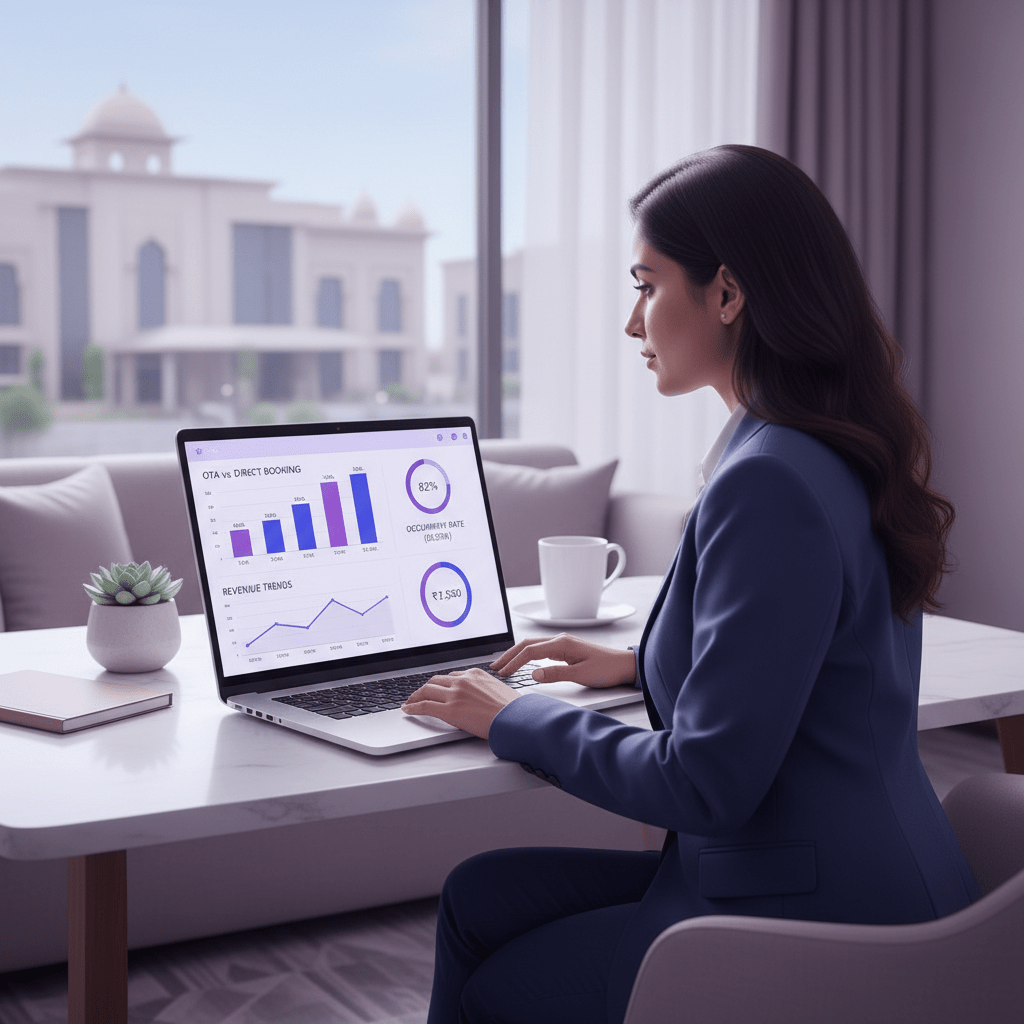
Surviving and Thriving in India’s Competitive Hospitality Market: Your Data Advantage
Ever notice how two hotels on the same street can feel miles apart in bookings? One is packed. The other is posting “special offer” banners like it’s a cry for help. Weird, right?
That’s the reality for a lot of hotels in India right now. Big chains have deep pockets. OTAs like MakeMyTrip and Goibibo pull in a huge share of online bookings. In fact, OTAs make up about 65% of online hotel bookings in India, and OTA hotel gross booking value hit ₹222 billion in FY23, which was 84% of total online hotel bookings, according to a VIDEC travel market study. That’s a big mountain to climb.
But here’s the good part. Data can help smaller hotels fight smarter, not louder.
Instead of guessing what guests want, you can look at the numbers. Guest data analysis for hotels shows who books, when they book, what they spend, and what makes them come back. That’s the shift from reactive marketing to data-driven marketing for hospitality. And once you start using hotel analytics tools and a good hotel CRM India setup, you stop shouting into the void.
You get a plan.
In this guide, we’ll look at what data to collect, how to read it, and how to use it to increase hotel bookings India-wide. We’ll also touch on ota vs direct bookings India, hotel marketing strategies India, and the small moves that can grow loyalty without burning cash on empty traffic.
If you’re using software like Ease My Hotel, this gets even easier. A single dashboard for booking management, guest communication, OTA sync, and reports can save a ton of time. And honestly, less spreadsheet chaos is a win for everyone.

1. The Foundation: Key Data Sources for a 360-Degree Guest View
You know that weird moment when a guest books on your site, asks a question on WhatsApp, then leaves a glowing Google review after checkout? That’s not three separate things. It’s one guest story.
And if you can read that story clearly, your digital marketing for hotels in India gets a whole lot smarter.
The first place to look is your PMS and CRS. These tools show booking patterns, stay length, lead time, repeat visits, and guest value over time. That means you can spot things like who books early, who comes back every winter, and which room types keep selling fastest. From what I’ve seen, this is where a lot of hotel marketing strategies India teams start to get real answers instead of guesses.
Then there’s website data. Google Analytics 4 can tell you where people come from, like Organic, PPC, or Social, and what they do before they book. Do they click your Deluxe Room page and leave? Do they keep checking your wedding packages? That stuff matters. It shows where people lose interest, which pages pull weight, and which ones just sit there looking pretty.
Here’s a quick look at the core data sources:
| Data Source | What It Tells You | Why It Helps |
|---|---|---|
| PMS / CRS | Booking trends, stay length, repeat guests | Helps with pricing, offers, and guest retention |
| Website Analytics | Traffic source, clicks, conversion rate | Shows what drives direct bookings |
| Guest Reviews | Likes, complaints, sentiment | Helps fix service gaps and marketing messages |
But don’t stop at numbers alone. Guest feedback and online reviews on TripAdvisor, Google Reviews, and OTA pages can tell you why people book or why they don’t. Most travelers check reviews before they book, so your reputation can shape demand before your sales team even says hello. A tired comment about slow check-in? That’s not just ops noise. It’s marketing data.
That’s why tools like Ease My Hotel are handy. When your booking management, OTA sync, guest communication, and reporting live in one place, you can actually use the data instead of hunting for it across six tabs and a notebook with coffee stains. Less chaos. Better decisions. And a cleaner path to increase hotel bookings India-wide.

2. Essential Analytics Tools for Your Hotel’s Digital Marketing Stack
You don’t need a giant budget to start. Really, you don’t.
A lot of hotel teams in India think data work means fancy dashboards, big reports, and a consultant who talks in circles. But the first wins usually come from free tools you can set up in an afternoon. And once those start making sense, you can add hotel analytics tools that connect your PMS, booking engine, and guest messages.
Start with the free stuff first
If you only set up three tools this week, make them these:
| Data Source | What It Tells You | Why It Helps |
|---|---|---|
| PMS / CRS | Booking trends, stay length, repeat guests | Helps with pricing, offers, and guest retention |
| Website Analytics | Traffic source, clicks, conversion rate | Shows what drives direct bookings |
| Guest Reviews | Likes, complaints, sentiment | Helps fix service gaps and marketing messages |
GA4 is the simplest first step for digital marketing for hotels in India. It shows where people come from, what pages they read, and where they drop off. Maybe they visit your wedding page and leave. Maybe they keep coming back to the room photos. That’s useful stuff.
Search Console fills in the search side. It tells you which words people used before they reached your site. So if travelers keep searching for “resort near Jaipur fort” or “business hotel in Bangalore with parking,” you can shape your pages around that intent.
And yes, social media analytics matter too. If your Instagram reels about pool views get lots of saves but your room posts flop, that’s not random. That’s your audience talking.
Hotel-specific tools help connect the dots
Free tools are great, but they don’t tell the whole story. A hotel CRM India setup or a BI tool can connect bookings, guest history, and marketing data in one place. That’s where data-driven marketing for hospitality starts feeling less messy.
Some common options are Revinate for guest email and segmentation, StayNTouch for cloud PMS and reporting, and Indian-friendly tools like Hotelogix, Zoho CRM, and Bingo CRM. For smaller properties, tools like Zoho can be a nice start because they’re easier on the wallet and work well with WhatsApp, which most Indian guests already use anyway.
Here’s the real value: these tools help you segment guests. Business travelers. Weekend couples. Families. Repeat guests who always book in December. Once you can sort people like that, your emails and offers stop sounding like spam.
Review tools turn opinions into patterns
This part gets ignored way too often. But guest reviews are packed with clues.
Platforms that pull reviews from Google, TripAdvisor, and OTA pages can help you track what people love and what keeps annoying them. Clean rooms. Fast check-in. Slow breakfast service. Loud AC. All of it matters. And because most travelers read reviews before booking, this is a big deal for hotel marketing strategies India teams.
A simple sentiment score can help you spot patterns faster than reading every review one by one. If 18 guests mention slow Wi-Fi in one month, you’ve got a real problem. If 30 guests praise the rooftop view, that’s a message you should put in your ads and website copy.
Actually, wait, there’s a better way to think about it. Reviews are not just feedback. They’re content ideas, service alerts, and sales notes all rolled into one.
So if you’re trying to increase hotel bookings India-wide, start with GA4 and Search Console, then add a hotel CRM or PMS tool, and finally use review tracking to keep your message honest. Ease My Hotel fits well here too, since it brings booking management, OTA sync, guest communication, and reports into one dashboard. Less tab-hopping. More action.
Try Ease My Hotel for free.
No lock-in contracts. Cancel anytime
3. Analyzing Key Metrics to Drive Hotel Marketing Strategies in India
You know that sinking feeling when a room looks full, but the cash drawer still feels light? That’s because occupancy alone can fool you. Full isn’t always profitable. Weird, but true.
If we’re talking about digital marketing for hotels in India, we need to look past vanity numbers and get into the money side of the story. That means checking RevPAR, ADR, guest value, and where each booking came from. It also means asking a simple question: which channel actually pays off?
Look beyond occupancy
RevPAR, or revenue per available room, tells you how much money each room is making on average. ADR, or average daily rate, tells you what guests are paying per night. Together, they help you see if your hotel marketing strategies India team is bringing in the right kind of guest, not just more guests.
Here’s a quick view of what these numbers can look like in India:
| Metric | What it means | Example in India |
|---|---|---|
| ADR | Average room price per night | National organized sector average was about ₹8,055 |
| RevPAR | Revenue per room available | National organized sector average was about ₹5,439 |
| Luxury ADR | Higher-end room rates | Around ₹15,655 for five-star deluxe hotels |
| Budget ADR | Lower room rates | Around ₹6,931 for two- and three-star hotels |
A recent Indian hospitality trends report shows how much these numbers shift by city and segment. Delhi, Mumbai, and Bangalore all behave a little differently, so copying one city’s pricing playbook to another can backfire fast.
And that’s where guest data analysis for hotels starts to pay off. If your weekend couples spend more on spa add-ons than business travelers, you probably don’t want to market them the same way. If your direct guests stay longer and book better room types, that’s a clue too.
Cost to get a guest vs. what they bring later
Now, you might wonder, “How much should I spend on ads?” Fair question. The answer depends on customer acquisition cost, or CAC, and lifetime value, or LTV.
CAC is what you spend to win one guest through Google Ads, Meta Ads, SEO, or even email campaigns with paid boosts. LTV is the total money that guest brings over time, not just on the first stay. That includes room nights, food, spa, and repeat visits.
Here’s the simple version:
- Add up total spend to get the guest.
- Figure out how much that guest spends per visit.
- Multiply by how many times they come back.
- Compare that to CAC.
Let’s say a guest brings in ₹10,000 per stay, visits twice a year, and keeps coming for 5 years. That’s ₹100,000 before discounting. If your CAC is ₹2,000, that guest is worth a lot more than a one-time OTA shopper who never returns. See the difference?
This is why data-driven marketing for hospitality works best when you don’t just chase cheap clicks. A low-cost lead can still be a bad deal if they never book again.
OTA vs direct bookings India: follow the money
OTAs still hold a big chunk of the market. In India, they account for about 65% of online hotel bookings, and OTA hotel gross booking value hit ₹222 billion in FY23, which was 84% of total online hotel bookings, according to a VIDEC market study. So yes, they matter. A lot.
But direct bookings usually give you more control and better margins. OTAs often take commissions that hotels say can land in the 15% to 30% range. That’s a big bite. Plus, direct guests are easier to reach later with loyalty offers, repeat stay discounts, and personalized email campaigns.
So what should you track?
- Share of bookings from OTA vs direct
- ADR by channel
- Repeat rate by source
- Revenue per guest by source
- Cancellation rate by source
If your direct channel has a higher ADR and better repeat rate, that’s a strong sign to keep investing there. If your OTA guests book fast but cancel often, that tells you something too.
What to do next
Start with one clean dashboard. Track RevPAR, ADR, CAC, LTV, and booking source every week. Then compare channels side by side. That alone can change how you spend money.
If you’re using Ease My Hotel, this gets a lot easier because your booking management, OTA sync, guest communication, and reports live in one place. No more hunting through five exports and a half-dead spreadsheet. And honestly, that’s a relief.
Want a simple next step? Pick one channel, one guest type, and one month of data. Then see what it’s really doing for your hotel.

4. Applying Insights: Data-Driven Tactics to Supercharge Your Marketing
You know that funny little moment when a guest browses your site at 11:42 pm, leaves, then books two days later from an Instagram ad? That’s not luck. That’s a clue.
And if you’ve got the right data, you can do that more often.
SEO and content that match real search intent
Start with Search Console. It shows the words people already use. Not what we think they use. What they actually type.
If people keep searching for things like “best resorts in India for families,” “pet-friendly hotels near me,” or “heritage stay in Jaipur,” that should shape your blog posts and landing pages. A hotel in Udaipur can write about lake-view stays and wedding weekends. A business hotel in Bangalore can make a page for parking, late check-in, and fast Wi-Fi. Simple stuff. But it works.
Guest reviews help here too. If people keep praising your breakfast or talking about your quiet rooms, those phrases should show up on your site. Same if guests complain about slow check-in. That tells you what to fix and what to brag about (the honest stuff, not the fluffy stuff).
Try this simple content plan:
| Data clue | Content to make | Why it helps |
|---|---|---|
| Search terms from Search Console | Blog posts and landing pages | Matches what travelers are already looking for |
| Review themes | FAQ pages and service pages | Builds trust with real guest language |
| Top city or room searches | Location pages | Helps bring in nearby demand |
And yes, this is a big part of digital marketing for hotels in India. Good content isn’t about writing more. It’s about writing what people need right before they book.
Personalized email that doesn’t feel like spam
Here’s the thing. One big email blast to everyone usually gets ignored.
But a short, targeted message? That can bring people back.
Use your PMS or hotel CRM India setup to split guests by stay type, last visit, location, and booking window. Then send offers that feel like they were written for one person. Because, well, they should.
For example:
- A guest who stayed for a wedding in December can get a return offer for anniversary trips.
- A family that booked school holiday stays can get summer package emails.
- A business guest from Delhi can get weekday corporate rates or early check-in deals.
- Local guests can get staycation offers for long weekends.
If your guest data analysis for hotels shows that repeat guests book every 9 to 12 months, send a reminder around month 8. Not month 3. Timing matters more than perfect wording, honestly.
This is where data-driven marketing for hospitality starts feeling personal. And when guests feel remembered, they’re more likely to come back.
Paid ads that follow the almost-booked guest
Now for the part that usually gets people excited.
You can use website visitor data to run retargeting ads for people who started booking but didn’t finish. Maybe they checked room rates and got distracted. Maybe they wanted to compare your hotel with one in Goa. Happens all the time.
That’s where PPC and social ads help. Show them the exact room type they viewed. Show a clean photo of the pool. Show a direct booking perk like free breakfast or late checkout. Don’t be weird about it. Just be helpful.
You can also build lookalike audiences from your best guests. If your strongest guests are family travelers from Mumbai who stay three nights and spend on food, you can ask Meta or Google to find more people like them. That’s a smart way to increase hotel bookings India-wide without throwing money at random clicks.
A simple ad setup could look like this:
- Retarget site visitors who abandoned checkout.
- Build a lookalike audience from repeat guests.
- Run different ads for families, couples, and business travelers.
- Test one offer at a time so you know what works.
And don’t forget mobile. A lot of Indian travelers book on their phones, often after checking OTAs first. In fact, OTAs still control about 65% of online hotel bookings in India, with OTA hotel gross booking value reaching ₹222 billion in FY23, according to a VIDEC travel market study. That’s exactly why retargeting matters. People are already looking. You just need to show up again with a better reason to book direct.
Keep it all connected
The best part? These three tactics work better together.
SEO brings in search traffic. Email brings back past guests. Paid ads catch the ones who almost booked. That mix is what makes hotel marketing strategies India feel less random and more steady.
If you use Ease My Hotel, your booking management, guest communication, OTA sync, and reports all sit in one place. That means you can spot patterns faster and act on them without jumping across six tabs and three logins. Less mess. More bookings.
So if you want a simple next step, start with one thing this week: pull your top search terms, one guest segment, and one abandoned booking group. Then build one page, one email, and one ad around them. Small move. Real payoff.
5. Case Study: How a Heritage Hotel in Rajasthan Increased Direct Bookings by 35%
Picture this. A beautiful old haveli in Rajasthan, carved doors, courtyard tea, and sunset views that look straight out of a travel reel. But most bookings? Coming from OTAs. The guests were there, sure. But the hotel was paying for the privilege of meeting them.
That was the problem. The message was too broad. It tried to speak to everyone, and honestly, it spoke to no one.
The team took a step back and looked at the data already hiding in plain sight. They pulled info from their PMS and website analytics, then matched it with guest reviews and booking patterns. A clear group popped up again and again: couples looking for cultural stays, romantic getaways, and a bit of old-world charm. Not just a room. An experience.
So they changed the playbook.
They built new website pages around local heritage, private courtyards, folk evenings, and couple-friendly stays. They also ran social posts and short videos showing the property’s architecture, handmade decor, and nearby cultural spots. No flashy sales talk. Just the real thing. The kind of stuff people actually remember.
Here’s what changed after that:
| Metric | Before | After |
|---|---|---|
| Direct website bookings | Baseline | 35% higher |
| ADR | Baseline | 20% higher |
| Reviews mentioning “authentic experience” | Low | Noticeably higher |
That jump makes sense when you look at the bigger market too. OTAs still control about 65% of online hotel bookings in India, and OTA hotel gross booking value hit ₹222 billion in FY23, according to a VIDEC market study. So yes, OTAs matter. But direct bookings can grow when your message feels specific and your content matches what guests are already looking for.
The nice part? This hotel didn’t need a giant ad budget. It just needed better signals, cleaner data, and a story that fit the property.
If you run a heritage hotel, homestay, or resort, this is worth copying. Start with your guest data analysis for hotels. Look for the people who stay longer, spend more, and leave better reviews. Then shape your hotel marketing strategies India around them. A good hotel CRM India setup, plus a dashboard from Ease My Hotel, can help you keep booking data, guest communication, and OTA sync in one place so you’re not guessing from five different screens.
Small shift. Big difference. And when guests start saying “authentic experience” in their own words? That’s marketing gold.
From Guesswork to Growth: Your Next Steps in Data-Driven Hotel Marketing
You don’t need a magic trick. You need a cleaner read on what’s already happening.
That’s the big shift for digital marketing for hotels in india. Data helps you see which guests book, which pages sell, and which offers just eat money. It also helps with measuring hotel marketing ROI, so you’re not tossing cash at ads and hoping for the best. With OTAs still taking about 65% of online hotel bookings in India, and OTA hotel gross booking value at ₹222 billion in FY23, hotels that learn their numbers can fight back with more control and better margins VIDEC’s India travel market study.
So here’s your simple checklist:
- Audit your current data sources. Look at your PMS, website, reviews, and OTA reports.
- Learn one core tool well. Start with GA4 and watch traffic, drop-offs, and booking paths.
- Pick one metric this quarter. Booking Source is a great one. See where direct bookings beat OTA traffic, and where they don’t.
That’s enough to get moving. Not perfect. Just moving.
And once you do, the next step gets easier. Hotel marketing strategies india work best when guest data analysis for hotels, hotel crm india tools, and hotel analytics tools all point in the same direction. Even small properties can do this. Resorts, homestays, and city hotels too. Ease My Hotel can help here by keeping booking management, guest communication, OTA sync, and reports in one place, so your team spends less time hunting through tabs and more time improving stays.
The hotels that start now will be in a much better spot for AI-powered pricing, smarter guest messages, and personal offers later. Think of this as laying the floor before the house gets bigger. Slow at first, then suddenly you’ve got something solid.
Try Ease My Hotel for free.
No lock-in contracts. Cancel anytime