

Why Negative Reviews Are a Hotelier’s Greatest Untapped Opportunity
Hotels that respond to reviews get 21% more booking inquiries, and that number climbs to 24% when they answer more than half of their reviews. Think about that for a second. The reply you’re dreading might actually be bringing in guests.
You know that sinking feeling when a one-star review pops up on a Monday morning? Your stomach drops. Your face gets hot. Maybe you start typing a defensive reply in your head before you’ve even finished reading. I’ve been there (well, close enough), and honestly, it’s a normal reaction. Your team works hard, and one angry post can feel personal.
But here’s the thing. Future guests aren’t just reading the complaint. They’re reading you. About 72% of travelers say online reviews play a big part in where they book, so your reply is basically a live audition for everyone scrolling past.
A calm, kind, professional response does more than put out a fire. It’s a free marketing tool. It’s also a chance at real service recovery, where you win back an unhappy guest and show hundreds of others how you treat people.
That’s the whole idea behind how to handle negative reviews professionally. Here’s where we’re headed: first, why reviews hit your bottom line so hard. Then, how to build a simple strategy and write a response that works. Last, how to turn all that feedback into real improvements for your property.
Let’s start with the money.
The High Stakes: How Online Reviews Directly Impact Your Hotel’s Bottom Line
Reviews aren’t just feedback. They’re money, and you can actually see it in the numbers.
What One Rating Point Is Worth
A 2025 analysis of TripAdvisor ratings and monthly revenue at Texas hotels found that a one-point rise on a five-point scale lined up with 2.2% to 3.0% more revenue. On $1 million in yearly room revenue, that’s roughly $22,000 to $30,000. Not small.
Now, a quick caution. This is a link, not proof that ratings alone caused the gain. Your market, brand and pricing all play a part. Still, the pattern shows up again and again.
| Study | Rating change | What happened |
|---|---|---|
| Texas hotels (TripAdvisor, 2025) | +1 on a 5-point scale | 2.2% to 3.0% more revenue |
| ReviewPro global analysis | +1 on a 100-point index | 0.89% higher rate, 0.54% higher occupancy, 1.42% higher RevPAR |
| Travelocity study | +1 on a 5-point scale | Rates up 11.2% with the same demand |
Guests notice too. Expedia’s 2025 Traveler Value Index says 76% of consumers would pay more for a hotel with better reviews.
What Bad Reviews Do to Your OTA Ranking
Booking.com and Expedia don’t rank you on stars alone. Recent analysis points to conversion rate, daily rate, cancellations and listing quality too. So a highly rated hotel can still sit below a lower-rated rival that turns more searches into bookings.
But repeated complaints about cleanliness or service can drag down conversion, even when your headline score looks fine. Response speed also gets talked about a lot in 2026. Booking.com’s Preferred Partner program, for one, looks at average response time. And one 2026 audit found 58% of properties missed a 24-hour response standard. Easy place to get ahead.
The Guest Journey: Where Bookings Die or Get Saved
Picture a traveler comparing three hotels on a Sunday night. About 81% of travelers read reviews right before booking, so she lands on that one-star complaint about noise.
Next, she looks for your reply. Silence? She’s gone. A defensive rant? Gone even faster. But a calm, specific answer with a real fix can keep her right there.
So what does a good reply look like? Let’s build one.
The 4A Framework: Your Step-by-Step Method for a Perfect Response

Here’s a simple way to write a reply without panicking. I call it the 4A Framework: Acknowledge, Assess, Act, Assure. Four steps. Each one takes about a minute to write. And together they cover everything a worried reader (and an unhappy guest) wants to see.
Step 1: Acknowledge and Apologize
Start by saying thanks. Yes, even for the angry ones. Then name the exact problem the guest had, like the hair in the shower or the thumping music at 1am.
Specific beats generic every time. “We value your feedback” sounds like a robot. “I’m sorry the room wasn’t clean when you arrived” sounds like a person.
Keep the apology clean, too. Review Overhaul warns against lines like “I’m sorry if you were offended,” because that kind of wording shifts blame onto the guest. And skip the word “but” right after sorry. AskSuite recommends a direct apology with no qualifiers attached.
Step 2: Assess and Accept
Now say, in a sentence or two, what went wrong. No excuses. “We were fully booked” is an excuse. “Our housekeeping check missed it” is ownership.
Use “I” when you can. A manager saying “I’ve looked into this” feels far more real than “the hotel is looking into this.” Taking responsibility builds trust fast, and readers can feel the difference.
One rule: check the facts first. Pull the booking, ask the team, then write.
Step 3: Act and Announce
This is where most replies fall apart. “We’ll do better” means nothing. Name one real fix.
Maybe you added a bathroom check to the final room inspection. Maybe maintenance is testing the noisy vents. Hotel News Resource shares a sample reply about slow Wi-Fi that says the system has already been upgraded, and that detail is what makes it believable.
But only mention actions that really happened. Guests (and your own staff) will notice if you don’t follow through.
Step 4: Assure and Ask
Let them know this isn’t your normal standard. Then invite them to talk offline, with a real name and a direct contact. Sign it with a title, like “Maria Lopez, General Manager.”
Keep private stuff out of the public thread. No room numbers, no refund talk. Aim for roughly 75 to 150 words total. Short and warm wins.
What the 4As Look Like in Real Life
Let’s say a guest writes: “Dirty room. Hair in the shower and dust everywhere. Won’t be back.” Here’s the difference a framework makes.
| Poor Response Example | Excellent Response Example (Using the 4A Framework) |
|---|---|
| “We’re sorry you feel that way, but our rooms are cleaned to the highest standards.” | Acknowledge: “Hi Dana, thank you for telling us. I’m sorry you found hair in the shower and dust on the shelves.” |
| “No other guests have complained about this.” | Assess: “That’s not the clean room you deserved. Our final inspection missed it on the day you stayed.” |
| “We hope you’ll consider booking with us again.” | Act: “I’ve reviewed this with our housekeeping team, added a bathroom check to every inspection, and a supervisor now signs off each room before check-in.” |
| (No contact, no name, no follow up) | Assure: “This isn’t our standard. Please email me at [email] so I can make this right. Maria Lopez, General Manager” |
See it? The first reply argues. The second one listens, owns it and fixes it. Same complaint, totally different story for the next traveler scrolling by.
Of course, writing one great reply is the easy part. Doing it every day, for every review, is where you need a system.
Building Your Response System: From Reactive Panic to Proactive Professionalism

A great reply is one thing. A reply that goes out every single time, on schedule, no matter who’s working that day? That’s a system. And honestly, it’s what separates hotels that look calm from hotels that look scrambled.
Here’s how to build one without hiring a whole new team.
Set Your Ground Rules First
Start with three simple decisions. Write them down. Tape them somewhere people can see them.
- Who owns it? Pick one person to watch for new reviews and one backup. Everyone else shouldn’t have to guess.
- How fast? Set a clock. Shoot for 6 to 12 hours on serious complaints and 24 hours on everything else. One 2026 report put the average hotel response time at 3.5 days, so even a 24-hour promise puts you well ahead.
- What’s our voice? Agree on a tone. Warm, plain, first person. No sarcasm, no legal talk, no arguing.
Also, decide when a review goes up the ladder. Here’s a simple version.
| Review type | Who handles it | Target time |
|---|---|---|
| Safety, discrimination, fraud, privacy or injury | General Manager (plus legal if needed) | 6 to 12 hours |
| 1 to 2 stars, regular complaint | Duty or front desk manager | Within 24 hours |
| 3 stars | Front desk manager | Within 48 hours |
| 4 to 5 stars | Front desk team using approved wording | Within 72 hours |
One tip that’s easy to miss: start the clock when the review shows up in your inbox, not when someone happens to spot it.
Stop Checking Five Tabs
If you’re opening Google, TripAdvisor, Booking.com and Expedia one by one, you’ll miss something. It’s just a matter of when. A busy Friday and a missed one-star review is a pretty common combo.
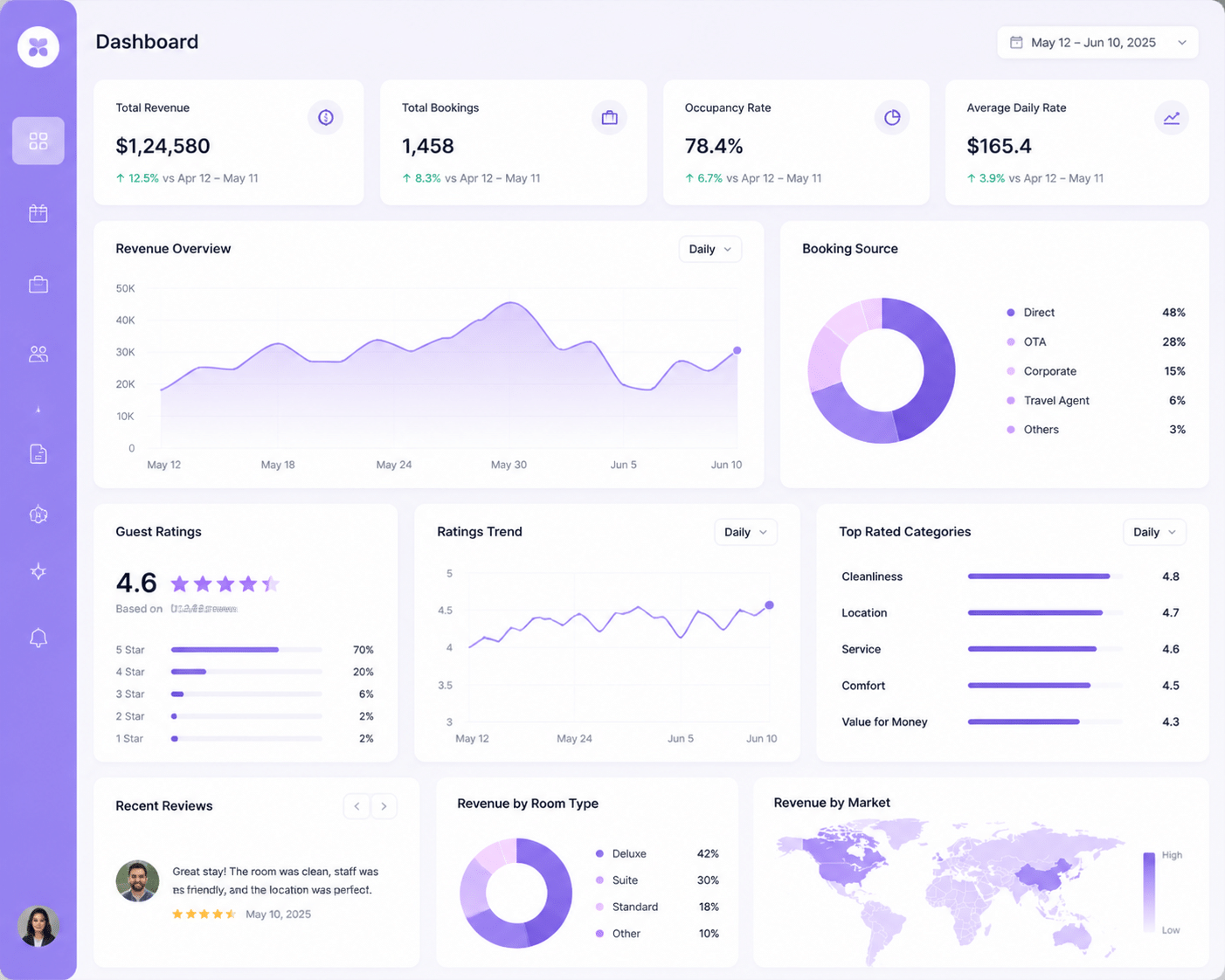
The fix is one central inbox. Good reputation tools pull reviews from every channel into a single feed, so nothing slips through. That’s the idea behind a unified dashboard in a cloud system like Ease My Hotel. Bookings, guest messages and feedback sit in one place, so your team sees the whole picture instead of piecing it together from separate screens.
What should that dashboard do for you?
- Show new reviews from all channels in one list
- Alert the right person fast
- Track who replied and how long it took
- Flag repeat complaints (like noise or slow check-in)
Review Response Workflow
Here’s the path every review should follow, from the first alert to the last follow up.
- Notification: A new review lands in the central inbox and the owner gets an alert.
- Triage: Check the star rating and topic. Safety or legal issue? Escalate right away.
- Verify: Pull the booking and ask the department what happened.
- Draft: Use a template, then personalize it with the 4A Framework.
- Approve and post: A manager gives it a quick read for tone and privacy.
- Follow up: Take the guest offline, log the fix and tell the team.
Six steps. Most take minutes.
Build a Template Library (Then Break the Templates)
Templates save hours. But a copy-pasted reply is easy to spot, and readers hate it.
So make a small library for your most common issues: cleanliness, noise, slow check-in, Wi-Fi, breakfast, staff attitude and billing. Each template should have blanks to fill in, like this:
Thank you for sharing this, [Name]. I’m sorry that [specific problem] affected your stay. That’s not the experience we want guests to have. I’ve reviewed it with our [department] team and we’ve [specific action]. Please contact me at [direct contact] so I can make this right. [Name, title]
The blanks are the point. Add the guest’s name, the real problem and one true action every time. Template for the skeleton, you for the heart. Don’t forget to review the library every few months, because a stale template with an old fix sounds worse than no template at all.
Once replies go out fast and sound human, there’s another case that needs its own playbook: reviews that are simply fake.
Try Ease My Hotel for free.
No lock-in contracts. Cancel anytime
Special Case: How to Handle Fake, Malicious, or Unreasonable Reviews
Some reviews aren’t really reviews. They’re attacks, mistakes or plain made-up stories. And you can’t answer them like a regular complaint.
So let’s slow down and sort the real from the fake first.
How to Spot a Fake Review
A harsh review isn’t a fake review. Guests are allowed to be unfair, grumpy and wrong. What you’re hunting for is a policy break, not a bruised ego.
Check for these signs:
- No stay on record. Search the name, dates and booking channel. Nothing there? That’s your biggest clue.
- Vague complaints. “Worst place ever” with no details about a room, a person or a day.
- Facts that don’t fit. The review mentions a pool you don’t have, or a staff member who wasn’t working then.
- Wild emotion. All caps, threats, insults and zero real story.
- A competitor plug. “Stay at Hotel Sunrise down the road instead!” Pretty obvious, right?
Write down what you find. Screenshots help. Dates help more.
How to Report It (and What to Send)
Every platform has its own door, and each wants proof of a rule break. Google bans fabricated, paid and competitor reviews. Booking.com flags reviews tied to stays that never happened. Tripadvisor investigates fraud, including owner and competitor manipulation.
| Platform | How to report | What to include |
|---|---|---|
| Open your Google Business Profile, find the review and choose to report it | The policy it breaks, plus a note that no matching guest or stay exists | |
| Booking.com | Contact Customer Service through your extranet, and their Fraud team investigates | Reservation search results, review date and why the stay isn’t real |
| Tripadvisor | Use the flag or report option on the review in your Management Center | Proof of the competitor link, no-stay records or false facility claims |
Be specific. “This review is unfair” gets you nowhere. “No reservation exists under this name for those dates” gets you a real look.
One hard rule: never offer a guest money or perks to delete a review. Google prohibits incentives tied to removing reviews, and it can backfire badly.
Also, I haven’t found any solid public numbers on how often removal requests win. So don’t count on it.
If the Review Stays Up
Sometimes the platform says no. Fine. Now you answer publicly, and you do it calmly.
State the facts. Say you can’t find a stay. Skip the accusations, because calling someone a liar looks worse than the review does. Then reaffirm that you love honest guest feedback.
Here’s a reply you can adapt:
Thank you for your feedback. We take every guest concern seriously, but we can’t find a reservation that matches the details in this review. To protect guest privacy, we can’t discuss bookings here. Please contact [manager’s name and title] at [private email or phone] with your stay dates and booking name so we can look into it. We welcome honest feedback from every guest, and we’ve shared this review with [platform] for review under its content policies.
Short. Polite. Factual. Future guests will see a hotel that stays cool, and that’s the real audience.
Of course, even real complaints can teach you something. Next, let’s look at what to do with all that feedback.
Beyond the Response: Turning Negative Feedback into Operational Gold
Here’s something I wish more hotel owners heard early on. A reply fixes one guest’s day. A pattern fixes your whole property.
Every angry review is free business intelligence. Guests just paid to tell you what’s broken (well, they paid for the room, but you know what I mean). The trick is reading them as a group, not one at a time.
Tag It, Count It, Spot the Pattern
You don’t need fancy software to start. A basic spreadsheet works fine for a small property. Copy in each review and add a few columns: date, channel, star rating, department, topic and what you did about it.
Keep your topic tags simple and the same every time. Think check-in, cleanliness, noise, breakfast, Wi-Fi, maintenance, staff, value. Then count. Three mentions of “slow check-in” in one month? That’s not bad luck. That’s a signal.
Here’s what a simple monthly report might look like. These numbers are made up, just to show the idea.
| Topic | Complaints (Sept) | Complaints (Oct) | Praise (Oct) | Action taken |
|---|---|---|---|---|
| Slow check-in | 7 | 3 | 2 | Added a second desk agent from 3pm to 6pm |
| Wi-Fi | 5 | 5 | 1 | Router upgrade booked, not done yet |
| Breakfast quality | 4 | 2 | 9 | New egg station, menu refreshed |
| Housekeeping | 6 | 4 | 11 | Bathroom check added to final inspection |
See the Wi-Fi row? Same count two months running. That tells you the fix hasn’t landed. A good reporting tool, like the ones in Ease My Hotel, can pull review counts, response times and guest feedback together so you’re not building this by hand every month.
Share It With the Team (Without the Blame)
Numbers sitting in a folder don’t change anything. People do.
Use real reviews in your morning briefings, but strip out names and room numbers. Read a complaint about a cold shower, then ask the maintenance team what they’d change. Read a glowing note about a front desk agent’s clear check-in explanation, and say it out loud. Specific praise beats “good job” every time.
One rule I like: criticize the process, recognize the people. If a handoff between housekeeping and engineering keeps failing, that’s a process problem. Let the team who lives it suggest the fix. They usually know it already.
Connect Complaints to Fixes in Your System
Now tie it together. When a guest complains about a noisy air conditioner, add a note to their guest profile. Assign a task to maintenance with a due date. Mark it done when the unit is checked.
That’s the whole loop: complaint, task, resolution, record. With staff management tools in a system like Ease My Hotel, you can assign the work to a real person, see when it’s finished and spot if the same room keeps coming up. Nothing lives in someone’s head or on a sticky note that fell behind the desk.
Fix the root cause and the next review often never gets written. Which brings us to the bigger picture.
Transform Your Approach: From Fearing Reviews to Leveraging Them
That sinking Monday morning feeling? It doesn’t have to stay. A bad review is a fact of life in hotels, and you won’t stop them all. But how you answer is up to you.
Here’s a quick look at what we covered.
Your Key Takeaways
| Step | What to do |
|---|---|
| Acknowledge | Thank the guest and name the exact problem |
| Assess | Own what went wrong, with no excuses |
| Act | Share one real fix you’ve already made |
| Assure | Offer a named contact and take it offline |
| Respond, learn, improve | Reply fast, spot the patterns, fix the root cause |
A clear, kind and professional plan isn’t optional anymore. Travelers are watching how you handle the hard stuff.
And there’s good news here. According to a 2026 hospitality guide, two out of three people who write negative hotel reviews are more likely to return when the hotel addresses the issue in its response. Treat that number as a hopeful hint, not a promise. Still, it says an angry guest isn’t always a lost guest.
So stop aiming for zero complaints. Aim for the kind of replies that build trust. Don’t defend the mistake. Show the fix.
Turning criticism into loyalty takes more than one good reply, though. You need a way to watch every channel, talk to guests quickly and track repeat complaints. Ease My Hotel can be the foundation for that, bringing guest communication and reputation management together in one cloud system. Start small this week, answer your next review with the 4As, and see what happens.
Try Ease My Hotel for free.
No lock-in contracts. Cancel anytime