

Why Mastering GST is Non-Negotiable for Indian Hotels in 2026

On 31 December 2025, Maharashtra authorities sent Chalet Hotels a GST demand of ₹160.02 crore for one financial year. According to the company’s disclosure, that was ₹47.44 crore in tax, ₹65.13 crore in interest and ₹47.45 crore in penalty. Read that again. The penalty and interest together were bigger than the tax itself.
Now, you probably don’t run a listed hotel chain. But the same thing happens at smaller scale every day. A wrong rate on a room bill. A missed input tax credit match. A late return. Each one quietly eats into profit and cash flow, and most property managers only notice when a notice lands on the desk.
And the rules keep moving. The Ministry of Tourism noted that GST rates on hotel rooms changed on 22 September 2025. If your billing didn’t change with it, you may already have a gap.
Here’s the flip side, though. A tidy GST system saves real money. You claim the credits you’re owed, you skip the penalties, and your team stops burning hours fixing invoices at month end. Audits feel a lot less scary when your records are clean. Your reputation with corporate clients stays clean too.
I’ll be honest: I can’t give you one magic number for what poor compliance costs the whole industry. Nobody has published a reliable one. What we do have are real cases, and they’re loud enough.
So this guide walks you through Indian hotel taxation, step by step, in plain language. We’ll also look at how modern tools, like Ease My Hotel, can take most of the manual work off your plate.
GST for Hotels Explained: Understanding the Core Components (CGST, SGST, IGST)

GST looks scary until you see it’s just three labels. Which label goes on your bill depends on one question: where does the service happen?
The Three Taxes in Plain Words
CGST is the Central GST. It goes to the central government. SGST is the State GST. It goes to the state where your hotel sits. IGST is the Integrated GST, used when a supply crosses state lines.
For a normal room stay, the tax is split in two halves: CGST plus SGST. Take a ₹10,000 room in Jaipur taxed at 18%. That’s ₹900 CGST and ₹900 SGST, so the guest pays ₹11,800.
Now the part that trips people up. Say the guest lives in Delhi. Does that make it IGST? Nope. Same bill, same split.
Place of Supply: Your Hotel’s Address Decides
Place of supply just means “where GST considers the service to be delivered.” For hotel rooms, section 12(3)(b) of the IGST Act points to the location of the property. The guest’s home state, passport or card doesn’t change that.
The same goes for corporate bookings. A Delhi-registered company sends an employee to your Mumbai hotel? You still charge CGST plus Maharashtra SGST. Record their GSTIN correctly, but don’t switch to IGST just because the head office is somewhere else.
Here’s a quick cheat sheet:
| Situation | Place of supply | Tax on the invoice |
|---|---|---|
| Delhi guest stays at your Jaipur hotel | Rajasthan | CGST + Rajasthan SGST |
| Delhi company books a room at your Mumbai hotel | Maharashtra | CGST + Maharashtra SGST |
| Your Maharashtra office sells a separate consulting service to a Karnataka company | Depends on that service’s own rule | Possibly IGST |
| One property spread across two states | Split by nights stayed | Each state’s own tax, per Rule 4 |
See the pattern? IGST is the exception for hotels, not the default.
What About Packages?
Packages are where it gets a bit messy. Think of a weekend deal with a room, meals and a spa session, sold at one price.
When items are bundled and naturally go together, GST can treat the whole thing as a composite supply. That generally means the whole bundle is taxed at the rate of the main item, which for most stay packages is the room. But if the spa or a banquet is sold on its own line, it may need its own rate and code. I’m not a tax advisor, so check tricky packages with yours before you print the brochure.
A good habit: list each service on the invoice, even inside a package. Software like Ease My Hotel can keep those lines separate for you.
Next, we’ll look at the rate slabs and codes that go with each line.
Navigating GST Rate Slabs & SAC Codes for All Hotel Services
I’ll admit it. The first time I opened a hotel GST rate chart, I closed it again. Too many numbers. So let’s keep this simple: every line on your bill needs two things, a rate and a code.
Room Rates: The ₹7,500 Line
Room tax depends on the room’s declared tariff per night. As of October 2026, the slabs changed after the 56th GST Council meeting, with new rates from 22 September 2025:
- Up to ₹1,000 a night: exempt
- ₹1,001 to ₹7,500: 5%
- Above ₹7,500: 18%
Heads up. Plenty of older charts online still show 12% and 28%. If your billing screen shows those, fix it now.
One more thing. The slab follows the declared tariff, but tax is charged on the amount the guest actually pays. So a room with an ₹8,000 tariff sold at ₹6,500 in a flash sale usually stays in the 18% slab. Not sure about a tricky case? Ask your tax advisor first.
Food, Banquets and Other Extras
Restaurants inside hotels are the confusing part. The rate depends on whether your hotel counts as a “specified premises,” which is linked to your room tariffs. If it does, restaurant service is taxed at 18% with input credit. If not, it’s usually 5% with no credit. The Economic Times explains how that changes a guest’s dining bill. Room service follows the same rule as your restaurant.
Banquet halls, event services, spa sessions and laundry are simpler. They’re generally taxed at 18%. If you also run a property with several revenue lines, this TaxGuru guide shows how multiple rates can sit under one roof.
What SAC Codes Are and Where They Go
A SAC is a Services Accounting Code. Think of it as a service barcode. It’s a number that tells the tax system what you sold, and it belongs on every invoice line. The full list sits in the CBIC classification scheme for services.
Here’s the chart to save or print.
GST Rate and SAC Code Chart for Indian Hotel Services (2026)
| Hotel service | GST rate | Input tax credit | SAC code |
|---|---|---|---|
| Room, tariff up to ₹1,000 | Exempt | Not applicable | 996311 |
| Room, tariff ₹1,001 to ₹7,500 | 5% | Generally no | 996311 |
| Room, tariff above ₹7,500 | 18% | Yes | 996311 |
| Restaurant and room service (not specified premises) | 5% | No | 996332 |
| Restaurant and room service (specified premises) | 18% | Yes | 996332 |
| Banquet or conference hall rent | 18% | Yes | 997212 |
| Event management service | 18% | Yes | 998596 |
| Spa and wellness | 18% | Yes | 999722 |
| Laundry | 18% | Yes | 999712 |
I’d double check the spa, laundry and event codes against the CBIC scheme before you load them anywhere. Small codes get mixed up a lot. Also, when catering comes bundled with a hall, the code and rate may change, so split the lines where you can.
This is where hotel management software with GST settings earns its keep. A tool like Ease My Hotel lets you set the rate and code once per service, instead of retyping them on every bill.
Next up: how to claim back the tax you pay on your own purchases.
Unlocking Hidden Savings: A Practical Guide to Input Tax Credit (ITC) for Hotels

You collect GST from guests. But you pay GST too, on almost every vendor bill. Input tax credit is how you stop paying tax twice on the same money.
What ITC Means in Plain Words
ITC is the tax you already paid on your purchases, used to reduce the tax you owe on your sales. Say you collected ₹18,000 in GST from banquet and room guests this month. You also paid ₹6,000 in GST on supplies and services. You send the government ₹12,000, not ₹18,000. Simple.
There’s a catch, though. The ITC rules on the CBIC site say you need a valid invoice, the purchase must be for business, and your supplier must have filed their return so the invoice shows up in GSTR-2B. Miss one piece and the credit can bounce.
Here’s the journey of one credit:
| Step | What happens |
|---|---|
| 1 | Vendor sends you a tax invoice with your GSTIN |
| 2 | Vendor files their return and pays the tax |
| 3 | The invoice appears in your GSTR-2B |
| 4 | You match it against your own books |
| 5 | You claim it in GSTR-3B |
| 6 | Your tax payable drops |
Where Hotels Can Usually Claim
Common claims include:
- Kitchen raw materials and supplies for a restaurant taxed at 18%
- Professional services like your CA, lawyer or consultant
- Repair and maintenance, such as AC servicing, plumbing and lift contracts
- Marketing, ads and photography
- Housekeeping supplies, linen cleaning and security services
- Software subscriptions and OTA commission invoices
One big warning. Credit mostly follows the supply it relates to. Costs tied only to 5% rooms or 5% restaurant service generally can’t be claimed. Shared costs, like a common generator contract, may need a partial reversal under Rule 42 or 43. This TaxGuru breakdown of Rule 42 reversals for hotels is worth a read before your next filing.
Where Credit Is Blocked
This is the pitfall. Section 17(5) shuts the door on several things hotels buy all the time:
- Construction of a building or other immovable property on your own account (renovation that gets capitalized often lands here)
- Food and beverages bought for staff or guests, in most cases
- Club memberships
- Passenger vehicles, with some exceptions
Food is the grey area. Staff meals are usually blocked unless an exception applies, such as the cost being part of a taxable package you charge for. A West Bengal advance ruling from January 2026 allowed credit for a hotel that re-billed food to a client at 18% GST. It’s one ruling, not a national rule, so ask your tax advisor first.
15 Documents to Keep for Every Claim
Auditors love paper trails. Keep these:
- Supplier tax invoices
- Debit notes
- Credit notes and amended invoices
- Purchase orders
- Contracts or service agreements
- Delivery challans
- Goods receipt notes
- Bank statements
- Payment vouchers
- GSTR-2B reconciliations
- Self-invoices for reverse charge
- Fixed asset register
- Department cost allocation sheets
- Rule 42/43 reversal workings
- Bills of entry for imports
Hotel accounting software, like the one inside Ease My Hotel, can tag each expense to a department. That makes the split between 5% and 18% income far less painful.
With credits sorted, let’s turn to the invoices and returns that carry them.
GST-Compliant Invoicing and Filing: A Step-by-Step Operational Workflow
Here’s a truth that took me a while to accept. Your GST return is only as good as the bills your front desk printed three weeks ago. Get the invoice right on day one, and filing becomes a quick check instead of a scramble.
What Goes on a Hotel GST Invoice
The CBIC invoice rules list the details a tax invoice must carry. For a hotel, here’s the practical version:
| Field | What to put there | Why it matters |
|---|---|---|
| Your details | Hotel name, address, GSTIN | Tells the system who sold the service |
| Invoice number and date | Unique, running number | Duplicates are a classic notice trigger |
| Guest or company details | Name, address, and GSTIN for B2B stays | A wrong GSTIN breaks your client’s credit claim |
| Description and SAC | “Room accommodation, 996311” and so on, per line | Each service needs its own code |
| Taxable value | Amount after discounts | Tax is charged on what the guest actually pays |
| Tax lines | CGST and SGST shown separately (IGST only when it truly applies) | Rate and rupee amount for each |
| Place of supply | Your property’s state | Remember, the hotel’s address decides this |
| Signature | Signed or digitally signed | Often forgotten on manual bills |
One habit pays off fast: capture the GSTIN at booking, not at checkout. Checkout is chaos. Nobody wants to hunt for a number while a queue builds behind them.
The Two Returns You Can’t Skip
Two returns matter most for hotels. GSTR-1 reports your outward supplies, meaning every invoice you issued. GSTR-3B is the summary return, where you report totals, subtract your input credit and actually pay the tax.
Here’s the usual monthly calendar. I’m not 100% sure it fits your case, because smaller businesses on the quarterly scheme (QRMP) get different dates. Check the portal before you plan around it.
| Return | What it covers | Usual monthly due date |
|---|---|---|
| GSTR-1 | Outward supplies (your invoices) | 11th of next month |
| GSTR-3B | Summary and tax payment | 20th of next month |
Miss a date and it costs money. The GST portal’s filing guide puts the GSTR-3B late fee at ₹50 a day (₹25 CGST plus ₹25 SGST) when tax is due, and ₹20 a day for a nil return. Interest on unpaid tax comes on top. GSTR-1 late fees follow a similar pattern, so check the portal amount before paying.
Why Daily Invoices Make Month End Easy
Picture the usual mess. Room bills sit in one tool, restaurant bills in a POS, banquet invoices in a spreadsheet. Come the 10th, someone is pasting numbers together at 9pm. That’s how duplicate invoice numbers, credit notes with no link to the original bill, and totals that don’t match happen.
A simple routine fixes most of it:
- Issue every invoice from one system, with the right SAC and rate.
- Check daily that the invoice register matches the day’s bookings.
- Link every credit note to its original invoice.
- Before the 11th, compare the register with your GSTR-1 data.
- Before the 20th, compare it again with your GSTR-3B totals.
This is where a hotel management system like Ease My Hotel earns its place, because room, restaurant and accounting data live together instead of in three silos.
Next, let’s see how software can do even more of this work for you.
Try Ease My Hotel for free.
No lock-in contracts. Cancel anytime
Automating GST Compliance: How Modern Hotel Software Solves Taxation Headaches
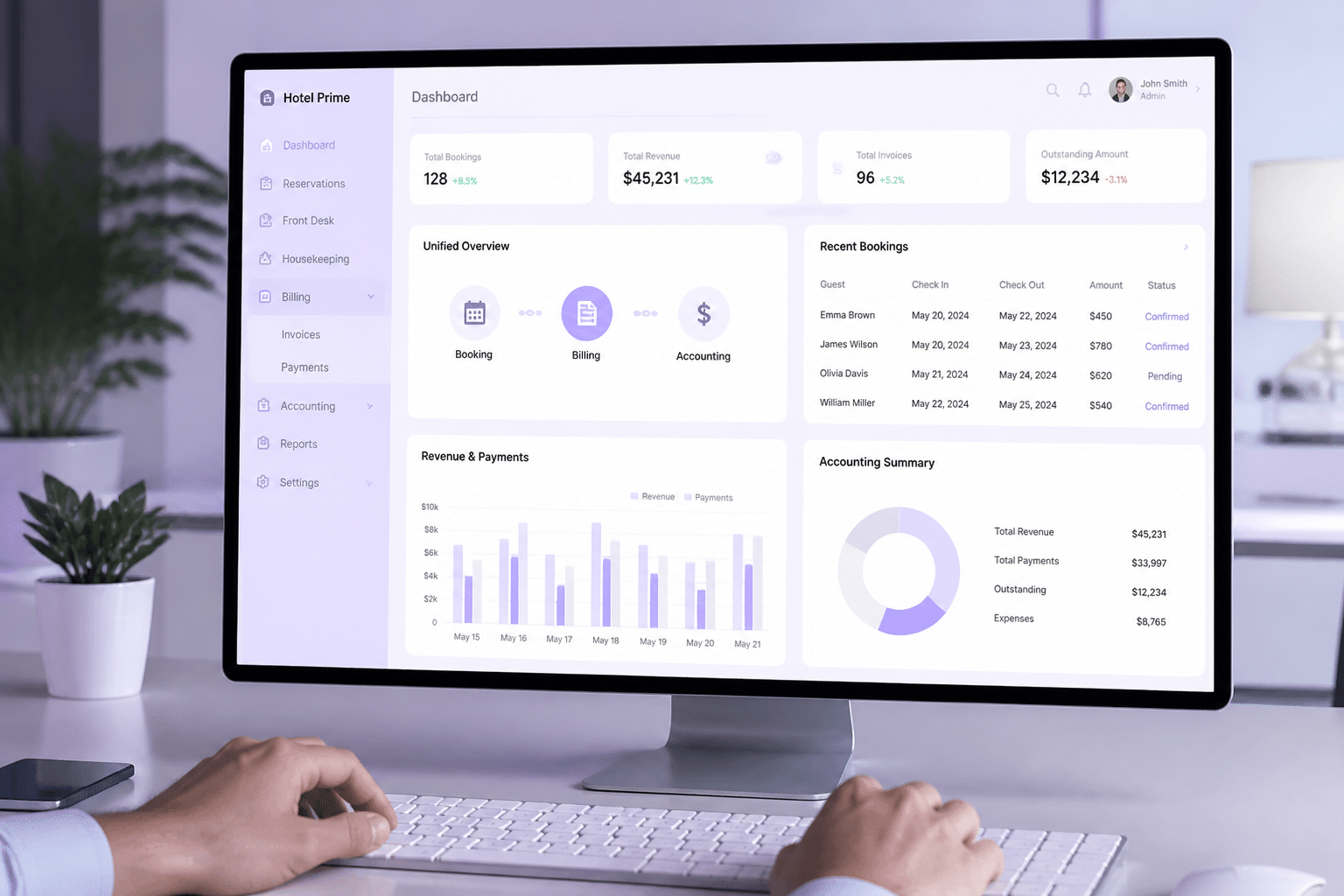
Picture month end at a 40-room hotel. Room bills live in one tool, restaurant bills in a POS, banquet invoices in a spreadsheet. Someone copies numbers across at 9pm and hopes nothing slips. Sound familiar?
That copy-paste habit is where most GST errors begin. A hotel management system with GST integration removes it. One system, one set of numbers, no retyping.
What a Unified System Actually Fixes
When room, restaurant and accounting data sit together, a booking becomes an invoice without anyone touching a calculator. I couldn’t find a trustworthy industry figure for how many accounting errors come from manual entry, so I won’t make one up. But the logic is simple. Every re-typed number is another chance for a wrong rate, a missing GSTIN or a duplicate invoice number.
Here’s a quick way to see your own risk. Say you raise 20,000 invoice lines a month and 1% need fixing. That’s 200 corrections. At roughly ₹300 of staff time each, you’re losing about ₹60,000 a month. It’s a made-up model, not a measured average, so plug in your own numbers.
Features Worth Looking For
Not every tool is built the same. Check for these:
- Automatic slabs: The software applies the right rate by service and nightly tariff, so a room crossing ₹7,500 gets 18% without anyone thinking about it.
- One-click invoices: Each line carries its SAC code, rate and CGST/SGST split, plus the guest’s GSTIN for B2B stays.
- Linked credit notes: Every refund points back to its original bill.
- GSTR-1 and GSTR-3B reports: B2B, B2C, rate-wise and SAC-wise totals, ready before the 11th and 20th.
- Audit trail: Locked periods, user permissions and a change log.
Also, ask for a live demo. Have the vendor show a split folio and a corrected invoice. That tells you more than any brochure.
Manual vs. Automated: A Side-by-Side
| Task | Manual management | Automated with integrated software |
|---|---|---|
| Applying GST rate | Staff look up slabs and key them in | Rate set once per service, applied automatically |
| Creating invoices | Typed or pasted from several tools | Generated from the booking in one click |
| Credit notes | Easy to leave unlinked | Tied to the original invoice |
| GSTR-1 and GSTR-3B data | Built from spreadsheets at month end | Reports pulled from daily records |
| ITC records | Scattered across folders and inboxes | Expenses tagged by department |
| Audit prep | Days spent hunting for paperwork | One searchable trail |
One Source of Truth for ITC and Audits
This is where an integrated setup, like Ease My Hotel’s accounting module alongside its booking and restaurant tools, really pays off. Your outward sales and your purchase expenses live in the same place. So separating 5% income from 18% income gets simpler, and so does your Rule 42/43 working.
Auditors ask the same thing every time: show me the trail. With one system, you can follow a number from the guest folio to the ledger to the return. Less panic, fewer late nights.
Some vendors do publish big savings claims. For example, a Hotelogix case study says one group saved over 1,500 man-hours a month. Treat that as a vendor claim, not a benchmark. Still, it shows where the time goes.
Software helps, but it can’t think for you. Next, let’s pull everything together into a tax strategy you can actually run.
Transforming Your Tax Strategy from a Burden into a Business Advantage
GST doesn’t have to feel like a monthly storm cloud. Look back at what we covered. Know your rules: CGST and SGST for a stay, the 5% and 18% room slabs, the right SAC on every line. Claim your input tax credit with care, and keep the paperwork that proves it. Then issue clean invoices on day one, so filing becomes a quick check instead of a scramble.
Those three habits do most of the work. Skip one and the other two wobble.
Your 3 Step Action List
You don’t need a big project plan. Start with this week:
- Audit your invoicing for SAC code accuracy. Pull 20 recent bills. Check each line for the right SAC, the right rate and the right CGST/SGST split.
- Review last quarter’s ITC claims. Look for credits you skipped, invoices missing from GSTR-2B, and shared costs that may need a Rule 42 or 43 reversal.
- Test how your software handles multi-rate GST. Try a room that crosses ₹7,500, a split folio and a corrected invoice. If staff have to fix things by hand, that’s your answer.
Not sure about a tricky case? Ask your tax advisor before you change anything. I’m not one, and rules shift.
Where Technology Fits In
Here’s my honest take. Software shouldn’t just keep you out of trouble. Once rates, codes and returns run in the background, your team gets hours back. Hours for faster check-ins, better reviews, smarter pricing and a phone that actually gets answered. That’s where revenue comes from.
GST will keep changing. Your system can change with it, quietly, without a panic at 9pm on the 19th.
Ready to simplify your hotel’s GST and accounting? See how Ease My Hotel brings bookings, restaurant billing and accounting into one all-in-one system, so your tax data is right from the first bill.
r
Try Ease My Hotel for free.
No lock-in contracts. Cancel anytime