
Why Your Competitors Are Winning on MakeMyTrip (And How You Can Fight Back)
You’ve got the rooms. The photos look decent. The beds are clean. The Wi-Fi works. So why is the hotel down the street pulling more MakeMyTrip bookings than you?
That gap stings. And it’s more common than most owners want to admit.
Here’s the thing. A huge share of hotel bookings in India now happens on OTAs like MakeMyTrip, so your hotel listing on MakeMyTrip can’t just sit there and hope for the best. One 2024 study found OTAs handled 84% of India’s online hotel gross booking value, and another source puts total hotel bookings through OTAs at 60% in 2023 VIDEC OTA benchmarking study.
So if your competitors are ranking higher, getting more clicks, and closing more stays, they’re probably not just “luckier.” They’ve likely done a better job with MakeMyTrip listing optimization.
That’s where competitor analysis comes in. It helps you analyze competitor hotels on MakeMyTrip, spot what they’re doing better, and use those clues to improve MMT property score, visibility, and revenue.
In this guide, we’ll break down the exact steps to read rival listings, spot hidden gaps, and turn those insights into practical MakeMyTrip extranet tips you can use right away. No fluff. Just a clear path to increase MakeMyTrip bookings and push your listing higher.
Deconstructing the MMT Ranking Algorithm: Key Factors for Visibility
You know that weird feeling when a hotel with fewer stars keeps showing up above yours? Yeah, that’s not random.
On MakeMyTrip, the listing order is shaped by more than just price. The platform uses a learning-to-rank system that looks at search context, seasonal demand, hotel metadata, recent CTR, conversion ratio, booking count, and click count. So if you want to know how to optimize listings in MakeMyTrip, you need to look at the same things MMT seems to care about.
Here’s the deal. The big pieces usually break down like this:
| MMT factor | What it means | What to watch |
|---|---|---|
| Conversion rate | How many visitors book | Search visits vs bookings |
| Property score | How strong your listing looks | Ratings, cleanliness, value, location |
| Price competitiveness | How your rate stacks up | Daily competitor pricing |
| Content score | How complete your page feels | Photos, room details, amenities |
| Engagement signals | How users react | CTR, time on page, clicks |
And yes, review score matters too. In the MMT extranet, you can track ranking, review score, and conversion rate side by side, which makes MMT competitor analysis a lot less guessy.
Actually, wait, there’s a better way to think about it. Your listing is not just a page. It’s a tiny sales pitch. If the photos are dark, the rate looks high, or the copy feels thin, people click away. That hurts your CTR, then your visibility, then your bookings. Ouch.
Pricing is another big one. Hotels that stay in line with local comps tend to do better, and some hoteliers use the built-in “Manage Your Competitors” tool inside GoMMT to keep an eye on rival rates. If that sounds like a chore, tools like RateGain, Lighthouse, and RateTiger can help too, plus they save a ton of manual checking.
Reviews are part of the story as well. Fast, friendly replies can help guest trust, and they can also make your hotel listing on MakeMyTrip feel alive instead of abandoned. A dead-looking listing is bad news. Nobody wants that.
Then there are the extras. MMT Assured, sponsored listings, and promo tools can give your property a push when your base listing is already in decent shape. Think of them like a louder megaphone, not a magic wand. If the page itself is weak, paid visibility just sends more people to a leaky bucket.
So if you want to improve MMT property score and increase MakeMyTrip bookings, start with the basics: tight pricing, strong photos, clear room info, fast review replies, and regular listing checks. If your team is juggling all this across OTA, front desk, and ops systems, a cloud PMS like Ease My Hotel can help keep bookings, guest messages, and channel updates in one place.
And one more thing. Do the simple stuff well, every week. That’s usually what separates the listings that rise from the ones that just sit there and hope.
Building Your Competitor Analysis Framework: Who to Watch and What to Track
Ever had that weird moment where a hotel two blocks away keeps beating you on MakeMyTrip, even though your place has better rooms, better service, and maybe even a better breakfast? Yep. That’s the part that makes owners squint at the screen and say, “Wait… how?”
The first fix is not guessing. It’s building a clean competitor set.
And here’s where a lot of people go sideways. They only watch the hotel next door. But your real competition is usually the property with the same star level, similar room type, similar guest mix, and a similar price band. A business hotel in Pune should not compare itself to a beach resort in Goa just because both show up in the same city search. That’s apples and oranges. Or maybe apples and hotel slippers.
Start with 5 to 8 hotels that match you on these points:
- Star rating
- Amenity level
- Guest profile, like families, couples, or business travelers
- Room type and size
- Price range
- Location type, like near a mall, station, airport, or landmark
Now, do your search like a real guest would. Not like an owner with insider tabs open everywhere.
Open an incognito window. Then search simple phrases like:
hotel near [landmark]family hotel in [city]budget stay near airportbusiness hotel in [city]
Look at the first page, then the second. That’s where the clues are hiding. You’ll see which listings MakeMyTrip is pushing, which ones have stronger photos, and which ones look like they were last touched during the first wave of WhatsApp groups. Not great.
From there, build a small tracker. Keep it boring. Boring is good here.
| Hotel name | Price weekday | Price weekend | Review score | Number of reviews | Photo count | MMT Assured | Current promotion |
|---|---|---|---|---|---|---|---|
| Hotel A | ₹4,200 | ₹4,800 | 4.3 | 612 | 28 | Yes | Free breakfast |
| Hotel B | ₹3,900 | ₹4,500 | 4.1 | 344 | 16 | No | Last-minute deal |
| Your hotel | ₹4,100 | ₹4,700 | 4.0 | 289 | 12 | No | None |
That table tells you a lot fast. Price gaps. Review gaps. Photo gaps. Promo gaps. All the little things that affect MakeMyTrip listing optimization.
If you want to improve MMT property score, don’t just stare at the numbers once and move on. Check them every week. A hotel that drops prices on Friday night, adds a fresh deal, and gets 15 new reviews can jump ahead before you even notice.
Also, if your team is trying to track all this by hand, it gets messy fast. A cloud PMS like Ease My Hotel can help keep bookings, guest messages, and channel updates in one place, so your team spends less time copy-pasting and more time fixing the stuff that actually moves bookings.
And one more thing. Don’t copy every rival move just because it looks shiny. Use the data. Pick the patterns that fit your hotel. That’s how you analyze competitor hotels on MakeMyTrip without turning your strategy into a guessing game.## The 7-Point Teardown: How to Analyze a Top-Performing MMT Listing
Ever clicked a MakeMyTrip listing and thought, “Why does this one feel so much better?” Same room type. Same city. Same price band. But one page just works.
That’s the one we want to study.
And honestly, this is where a lot of hoteliers leave money on the table. If you want to figure out how to optimize listings in MakeMyTrip, you can’t just look at the room rate and call it a day. You need to tear down the whole page like a guest would. The title. The photos. The reviews. The offers. The little stuff that makes a listing feel alive.
Why bother? Because OTA traffic is a huge piece of the pie in India. One 2024 benchmark found OTAs handled 84% of online hotel gross booking value in FY2023, and another study puts OTA hotel bookings at 60% in 2023. Plus, 79% of Indian accommodation providers say being on digital platforms brings in more bookings VIDEC’s OTA benchmarking study.
So yeah. The listing matters.
Here’s a simple 7-point teardown you can use to analyze competitor hotels on MakeMyTrip without getting lost in fluff.
1. Property title and first impression
Start with the name. Weirdly enough, the title does a lot of heavy lifting.
Look at the top listings in your area and ask:
- Do they use a clear property name?
- Do they add a location cue, like “near airport” or “city center”?
- Do they highlight a real USP, like a pool, free breakfast, or business-friendly stay?
- Does the title feel natural, or stuffed and awkward?
A good title usually tells you three things fast: what the property is, where it is, and why someone should care. If a competitor is showing up with sharper wording, that may be part of the reason they get more clicks.
And clicks matter. MMT’s own ranking system looks at things like click count, CTR, booking count, conversion ratio, and search context. So if a title gets attention, it can help the whole listing perform better. Makes sense, right?
Also check the description. Is it short and clean, or does it read like a dusty brochure from 2011? The best listings tend to use simple words and real guest wins. Think “walk to the metro,” “free Wi-Fi,” “24-hour front desk,” not vague lines like “luxury stay experience.” That stuff is tired.
2. Keywords and USP language
Now look for the words they keep repeating.
Do they mention:
- near airport
- family-friendly
- business hotel
- couple stay
- budget stay
- pet-friendly
- banquet hall
- free parking
Those words are clues. Competitors usually bake in search-friendly phrases that match how guests actually look for rooms.
This is where MakeMyTrip listing optimization gets practical. If your page says the same thing every hotel says, you blend in. But if your competitor’s page clearly says who it’s for, you get the idea fast. You don’t have to guess.
Actually, wait, there’s a better way to say this. A strong listing doesn’t try to sound fancy. It tries to be easy to understand in 5 seconds.
So check whether the property is using:
- location-based terms
- amenity-based terms
- guest-type terms
- room-type details
- event or business-use language
Then compare that with your own property page. If your hotel is close to an airport and your listing never says so, that’s a missed chance. Big one.
3. Photo count and photo quality
OK, this next part is actually pretty cool. Photos can make or break a listing.
Look at how many images your competitors are using. Then ask:
- Do they have at least 10 photos?
- Do they show rooms, bathrooms, exterior, common areas, and dining?
- Are the images bright and clear?
- Do they show different room types?
- Do they use landscape shots that feel professional?
Industry guidance for MMT says a listing should have at least 10 photos, and 25+ photos can lift conversion quite a bit. The suggested resolution is 1280×960px minimum, with 1920×1080px preferred. Videos up to 2 minutes are also supported, which is nice if you’ve got a lobby, pool, or rooftop view that actually looks good on camera.
Here’s a quick comparison table you can use during your MMT competitor analysis:
| Visual check | Top competitor | Your hotel |
|---|---|---|
| Total photos | 28 | 12 |
| Room shots | Yes | Yes |
| Bathroom shots | Yes | No |
| Exterior shot | Yes | Yes |
| Dining shot | Yes | No |
| Video | Yes | No |
See the gap? It’s not just about having photos. It’s about telling a full story.
And please, no blurry lobby shots from someone’s old phone. We’ve all seen those. They do not scream trust.
4. Promotions and pricing moves
Price is never just price.
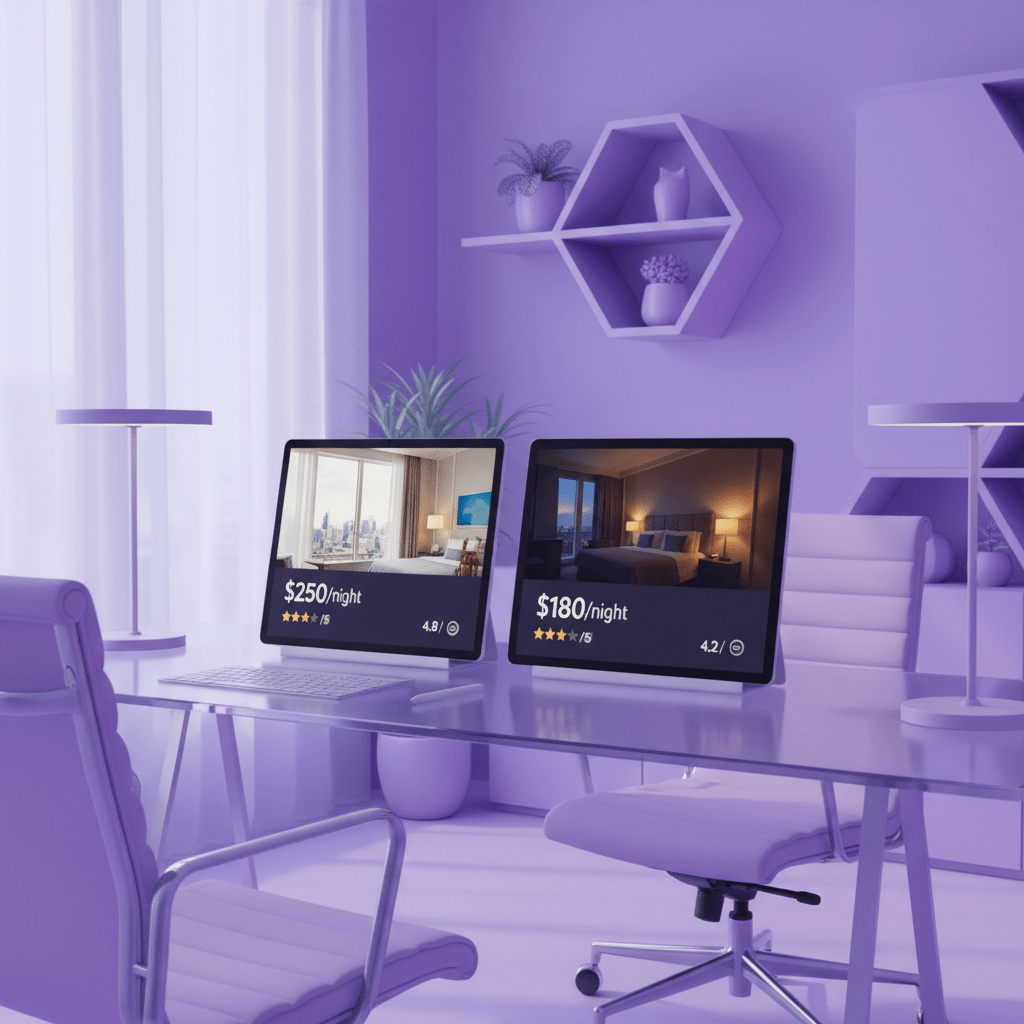
Check the listing on a weekday, then on a weekend. Check 7 days out, then 1 day out. Some top hotels change rates fast depending on demand, and many use short-term deals to stay visible.
Look for patterns like:
- free breakfast
- last-minute deals
- meal plans like CP, MAP, or AP
- flexible and non-refundable rate options
- member-only discounts
- flash promos
These offers matter because they change how guests compare options. A room at ₹4,100 with breakfast can feel better than one at ₹3,900 with nothing extra. Humans are funny like that. We love “free.”
Also, MMT has a built-in “Manage Your Competitors” tool in the extranet, so you can keep tabs on rival rates without doing everything by hand. If you want a broader view, third-party tools like RateGain, Lighthouse, and RateTiger can help too. But even a simple weekly price tracker beats guessing.
Here’s a quick pricing sheet style check:
| Check point | Competitor A | Your hotel |
|---|---|---|
| Weekday rate | ₹4,200 | ₹4,100 |
| Weekend rate | ₹4,800 | ₹4,700 |
| Breakfast included | Yes | No |
| Last-minute deal | Yes | No |
| Non-refundable option | Yes | Yes |
If the competitor is a little pricier but bundled better, they may still win the click.
5. Review score and review volume
Now let’s talk social proof. People trust people. Shocking, I know.
Review score is one thing. Review volume is another. A hotel with 4.4 stars and 600 reviews usually feels safer than one with 4.6 stars and 37 reviews. Guests see the first one as tested. The second one can feel a bit thin.
So check:
- overall review score
- total number of reviews
- recent review trends
- how often management replies
- how fast the replies show up
- whether replies sound human or copy-pasted
A lot of OTAs reward active engagement. Review responses can lift conversion and trust, and quick replies tend to make the listing feel cared for. A dead-looking page is bad news. Nobody wants to book a place that looks ignored.
And one more thing. Read the bad reviews. Not the five-star love notes. The complaints. That’s where the real gaps live. Maybe guests mention slow check-in, weak Wi-Fi, or poor breakfast variety. If your competitor is fixing those pain points in replies, that’s a clue.
6. Amenity match-up
Now cross-check the amenity list.
This is where people get lazy, and it costs them.
Compare your hotel to the top listings and look for things like:
- Wi-Fi
- breakfast
- parking
- air conditioning
- elevator
- laundry
- room service
- airport shuttle
- power backup
- pet-friendly stay
- meeting space
If a competitor has four more amenities than you, that can be enough to sway a guest. Sometimes it’s not about a huge price gap. It’s about feeling like the room covers more needs.
And yes, some amenities matter more for certain traveler types. Business guests care about Wi-Fi, desk space, and early check-in. Families want parking, breakfast, and bigger rooms. Couples notice cleanliness, view, and privacy. So don’t copy the whole list blindly. Match the guest.
Here’s a simple scorecard you can use:
| Amenity | Competitor | Your hotel | Gap? |
|---|---|---|---|
| Free Wi-Fi | Yes | Yes | No |
| Breakfast | Yes | No | Yes |
| Parking | Yes | Yes | No |
| Elevator | Yes | No | Yes |
| Airport shuttle | No | No | No |
| Meeting room | Yes | No | Yes |
That gap is where you can act.
7. Pull it all together
The real trick is not looking at one thing in isolation.
A top-performing MakeMyTrip listing usually has a clean title, sharp photos, a clear price story, strong reviews, and a room list that feels complete. When all of that lines up, the page looks trustworthy. And trust sells.
So after you finish the teardown, ask yourself three questions:
- What are they saying that we’re not?
- What photos do they have that we’re missing?
- What proof do they show that makes guests feel safe?
That’s your action list.
If your team is still juggling bookings, guest messages, and OTA updates in different places, a cloud PMS like Ease My Hotel can help bring everything into one dashboard. That makes it easier to spot gaps, update content faster, and keep your hotel listing on MakeMyTrip from falling behind.
And honestly, that’s the whole game. Study the best listings. Steal the good ideas. Fix your own page. Then keep checking every week, because competitors move fast and guests move even faster.## From Analysis to Action: Implementing Winning Changes in the MMT Extranet
You know that moment when you spot the fix, but the work still looks messy? Yeah. That’s this part.
At this point, you’ve already done the hard bit. You’ve looked at rival listings, compared photos, checked rates, and spotted where your hotel is slipping. Now we turn that into action inside the MakeMyTrip extranet. And honestly, this is where a lot of hotels either pull ahead or just keep talking about it.
First, update the content. Then update it again.
1. Refresh photos, fast
If a top competitor has 28 bright photos and you’ve got 12 dark ones from three years ago, fix that first. In the MMT extranet, go to Property Details and swap in clear, landscape shots with natural light. Show the room, bathroom, exterior, dining area, and common spaces. If you have a nice lobby or rooftop, put that in too. Guests do judge the book by the cover. Very much.
Use what you learned from competitor analysis. If their room photos show bigger beds, better angles, or cleaner staging, aim for that same feeling. Not fake. Just cleaner and more honest. And don’t forget the little stuff: no watermarks, no blurry pics, no duplicate uploads.
2. Rewrite the description like a guest would read it
Now for the copy. Keep it short. Keep it human.
If your competitor keeps saying “near airport,” “family stay,” or “free parking,” and those things are true for you too, say them clearly. That’s MakeMyTrip listing optimization in real life. Don’t stuff keywords in like you’re feeding a machine. Write the way a tired traveler thinks at 10 pm after a delayed flight.
Try a simple formula:
- What kind of stay is this?
- Where is it?
- What makes it easier?
- What should the guest expect?
Example: “A clean business hotel near the station with free Wi-Fi, early check-in, and easy access to shops and food.”
Simple. Clear. Done.
3. Tag every amenity properly
This sounds boring. It is boring. But boring work wins bookings.
Go through each amenity in the extranet and make sure it’s tagged right. Wi-Fi. Parking. Breakfast. Air conditioning. Elevator. Room service. Airport shuttle. If it exists, mark it. If it doesn’t, don’t guess. Guests hate surprises, and so do bad reviews.
A lot of MMT property score pain starts here. A hotel may offer an amenity in real life but never show it on the listing. That’s free value left on the table.
Try Ease My Hotel for free.
No lock-in contracts. Cancel anytime
Pricing and promotions that actually fight back
Here’s the deal. If your rival drops rates on Thursday night, you don’t need to panic. You need a plan.
Use your competitor tracker and set a price band, not a random number. Stay close enough to compete, but don’t race to the bottom every time. That’s a fast way to make everyone grumpy, including your finance team.
A good move is to match what guests feel, not just what they see. If a competitor is charging ₹4,200 with breakfast and you’re at ₹4,100 without it, you may be the weaker deal. Weird, right? But guests do that math fast.
Try these promotions in the MMT extranet:
- Last-minute deal for low-fill dates
- Free breakfast on weekends
- Meal plans for family travelers
- Flexible rate for business guests
- Non-refundable discount for advance bookers
And keep rate parity clean across channels. If your direct site, OTA, and walk-in rates are all over the place, guests notice. So do OTAs. If you use a cloud PMS like Ease My Hotel, it’s easier to keep booking flow, OTA updates, and channel rates in one place instead of juggling five tabs and a prayer.
Review replies that turn complaints into proof
This part matters more than people think. OTAs handle a huge share of hotel bookings in India, with studies putting the number anywhere from about 60% to 84% of online hotel bookings. And 79% of Indian accommodation providers say digital platforms bring in more bookings, according to VIDEC’s OTA benchmarking study. So yes, the review box is not just decoration.
Replying well can help trust. Fast replies help too. So write like a person.
For a positive review
“Thank you for staying with us, [Name]. We’re glad you enjoyed the room and the service. We’d love to welcome you back soon.”
For a negative review
“Thank you for your feedback, [Name]. We’re sorry the stay did not meet your hopes. We’re looking into the issue you mentioned and will work with our team to improve it. We’d like another chance to host you better next time.”
That’s calm. It’s respectful. And it shows future guests that you care.
If the complaint is about something real, don’t get defensive. Say sorry, explain briefly if needed, and point to the fix. If the guest said the Wi-Fi was weak, say you’ve checked it with the team. If breakfast was slow, say you’ve reviewed the process. Short. Clean. No drama.
And if you want the whole system to run smoother, tools like Ease My Hotel can help your staff keep bookings, guest messages, and OTA updates in one dashboard. Less chaos. Fewer missed replies. Better guest feel.
That’s the move. Update the page. Tighten the rate. Reply like a human. Then keep checking every week, because competitors don’t sit still.

Advanced Tactics: Using MMT Tools to Dominate Your Market
Ever watch a rival hotel pop up first on MakeMyTrip for a packed weekend, a big cricket match, or a local festival, and think, “Yep, there goes my booking”? I’ve seen that happen more times than I’d like to admit. Annoying. But fixable.
This is where the sharper moves come in. Not just basic MakeMyTrip listing optimization, but the stuff that helps you jump ahead right when demand spikes.
Use sponsored listings like a fast pass
MMT Ads, also called sponsored listings, can help your hotel show up faster for high-intent searches. Think busy dates, sold-out city centers, and travel windows where guests are ready to book now. They’re not a magic trick. But they can put you in front of people who are already looking.
That matters because India’s OTA share is huge. A 2024 study says OTAs handled 84% of online hotel gross booking value in FY2023, and other industry snapshots put hotel bookings through OTAs at around 60% to 63% in 2023, according to VIDEC’s OTA benchmarking study.
So if you’re trying to increase MakeMyTrip bookings for a wedding season, Diwali rush, or a conference week, sponsored placement can help you leapfrog slower competitors. Track the basics: impressions, CTR, bookings, and ROAS. If the ad brings clicks but no stays, the photo, rate, or offer probably needs a tune-up.
Match your listing to the moment
This part is easy to miss. Guests search differently during festivals, school breaks, and event weekends. So your listing should shift a little too.
For a local fair or trade show, highlight early check-in, Wi-Fi, airport or station access, and breakfast. For family travel, push bigger rooms, parking, and meal plans. For holiday weeks, short stay packages and flexible rates usually do better than a plain room-only pitch.
Here’s a simple way to think about it:
| Travel moment | What to highlight | What to offer |
|---|---|---|
| Festival weekend | Easy access, family stay, parking | Meal plan, flexible rate |
| Conference dates | Wi-Fi, desk space, location | Business package |
| Holiday break | Pool, breakfast, larger rooms | Stay 2 nights, save more |
| Last-minute travel | Fast check-in, near landmark | Same-day deal |
And yes, this also means updating your copy before the rush, not after everyone else has already filled up.
Test small things, then watch the numbers
OK, this next part is kind of fun. Run tiny tests.
Try one primary photo for two weeks, then swap to another one. Test a free breakfast offer against a small rate drop. Or compare “near station” wording with “city center” wording. You don’t need a giant lab setup. Just change one thing at a time and watch what happens in the MMT extranet.
Look at clicks, bookings, and conversion rate. If one version gets more taps but fewer stays, that’s useful too. It means the page is pulling attention, but something on the listing is scaring people off.
And if you’re juggling rates, messages, and OTA updates across a messy stack of tools, a cloud PMS like Ease My Hotel can keep your booking data, guest communication, and channel updates in one place. Less bouncing around. Fewer missed moves.
The big idea is simple. Use MMT Ads for speed, use seasonal tweaks for timing, and use A/B tests for proof. That’s how you stop guessing and start making the listing work harder for you.
Your Blueprint for Continuous Growth on MakeMyTrip
So here’s the real takeaway. Winning on MakeMyTrip is not luck, and it’s not a one-time fix either.
The best results usually follow a simple loop: Benchmark -> Analyze -> Optimize -> Measure. First, you compare your hotel to the right competitors. Then you study their title, photos, pricing, reviews, and offers. After that, you make smart updates in the MakeMyTrip extranet. And then you watch what changed.
That matters because OTA bookings are a huge piece of hotel demand in India, with studies putting the share at about 60% to 84% of online hotel bookings, and industry data from VIDEC shows most accommodation providers now see digital listings as a booking driver.
But here’s the part people miss. Competitor analysis is never “done.” Hotels change prices, add promos, upload new photos, and push for better visibility all the time. Your listing has to keep moving too. That’s how you improve MMT property score, increase MakeMyTrip bookings, and stay in the race.
So don’t wait for a slow month to act. This week, pick your number one competitor and run a full 7-point teardown. Find three quick wins you can fix right away. Maybe it’s photos. Maybe it’s breakfast. Maybe it’s a sharper description.
Small moves. Repeated often. That’s the play.

Try Ease My Hotel for free.
No lock-in contracts. Cancel anytime