
Why Your Biggest Revenue Opportunity Is Already in Your Guest Database
Picture this. A guest checks out on Sunday morning, smiles at the front desk, and never hears from you again. Meanwhile, you spend next week’s budget chasing a stranger on an OTA.
Sound familiar? We’ve all been there.
Here’s the part that stings. Adobe and Publicis Sapient’s 2025 research found that customer acquisition costs rose 35% from 2022 to 2025, while hotel customer lifetime value grew only 5.5%. You’re paying a lot more to get guests, and they’re not worth much more once they arrive.
| What the numbers say | Figure |
|---|---|
| Rise in acquisition cost (2022 to 2025) | 35% |
| Rise in hotel guest lifetime value | 5.5% |
| Average direct website booking | $519 |
| Average OTA booking | about $320 |
Direct guests return nearly 4x as often as OTA guests. In a study of 2.2 million European hotel guests, 5.1% of direct guests came back, compared with 1.3% of OTA guests.
So why do so many of us keep leaning on OTAs? Because it’s easy. Bookings show up, and we pay the commission. But the past guests sitting in your system, with names, emails, stay dates and room preferences, usually get ignored. That’s a goldmine collecting dust.
This is where smart email marketing comes in. Not random blasts. A real plan that thanks guests, reminds them, and invites them back to book direct. Do it well and one-time visitors turn into loyal repeat guests, which means more direct bookings and better profit.
Ready to see how? Let’s start with the list itself.
Foundation First: Building and Segmenting a High-Value Email List
Here’s a hard truth. A big list isn’t a good list. I’ve seen properties with 20,000 emails and almost no bookings to show for it.
So let’s fix the base first. Then the fancy campaigns actually work.
Where to Collect Guest Emails (Without Being Creepy)
The trick is simple: give guests a reason to say yes. And always keep marketing permission separate from the booking confirmation. No pre-ticked boxes. Ever.
Here are the easiest places to start:
- Online booking: You need the email for the confirmation anyway. Add one optional box for offers and updates.
- Check-in: Offer a digital arrival guide, receipt or Wi-Fi details by email. Tell guests what else they might get.
- Wi-Fi login page: Give access after an optional newsletter or local tips sign-up, instead of burying consent in long terms.
- Post-stay feedback form: Ask one useful question, like “Which would you try next time: dining, spa or family activities?” Add an optional subscribe box.
One more thing about OTA guests. Their emails are often masked, so don’t assume you can reach them. Invite them to share a real email at check-in or through a survey, with clear consent.
And does it pay off? Revinate’s analysis of 2.8 billion hotel emails points to about $5.89 in direct revenue for every guest email address captured. Not bad for one little form field.
Why Segmenting Beats Sending to Everyone
Having a list is step one. Sorting it is where the money shows up.
Think about it. Would you send the same email to a business traveler who stays Tuesdays and a family that visits every August? Probably not. (Well, you could. It just wouldn’t work.)
The same Revinate report found that segments under 5,000 contacts reached a 42.78% open rate and a 0.53% conversion rate. Segments over 50,000 managed just 0.06% conversion. That’s more than eight times lower.
Start with these four groups:
| Segment | What it tells you | Example email |
|---|---|---|
| Stay history | First-timer, repeat or lapsed | “Welcome back” or a win-back offer |
| Guest type | Business, leisure or family | Midweek rates, romantic packages or school holiday deals |
| Booking source | Direct or OTA | Invite OTA guests to book direct next time |
| Total spend | Big spenders vs. light spenders | Early access and perks for top guests |
Think of it as a funnel. You begin with all guests, narrow by guest type, then by how often they stay, and finally by how much they spend. The smaller the group, the more personal your message can be.
Let Your Software Do the Sorting
Now, you could build these groups by hand in a spreadsheet. I wouldn’t. It eats hours, and one typo can send a “welcome back” note to someone who’s never stayed.
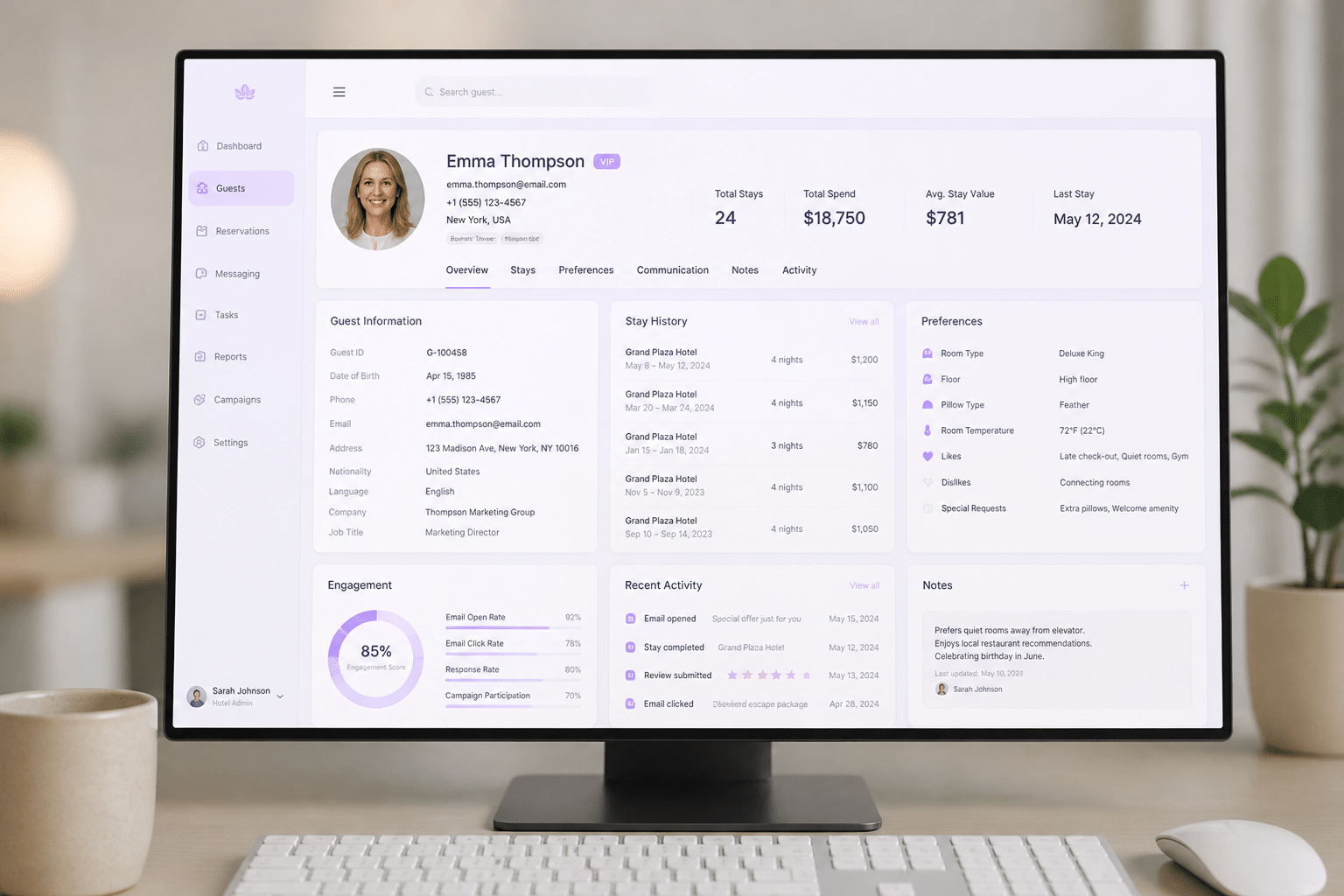
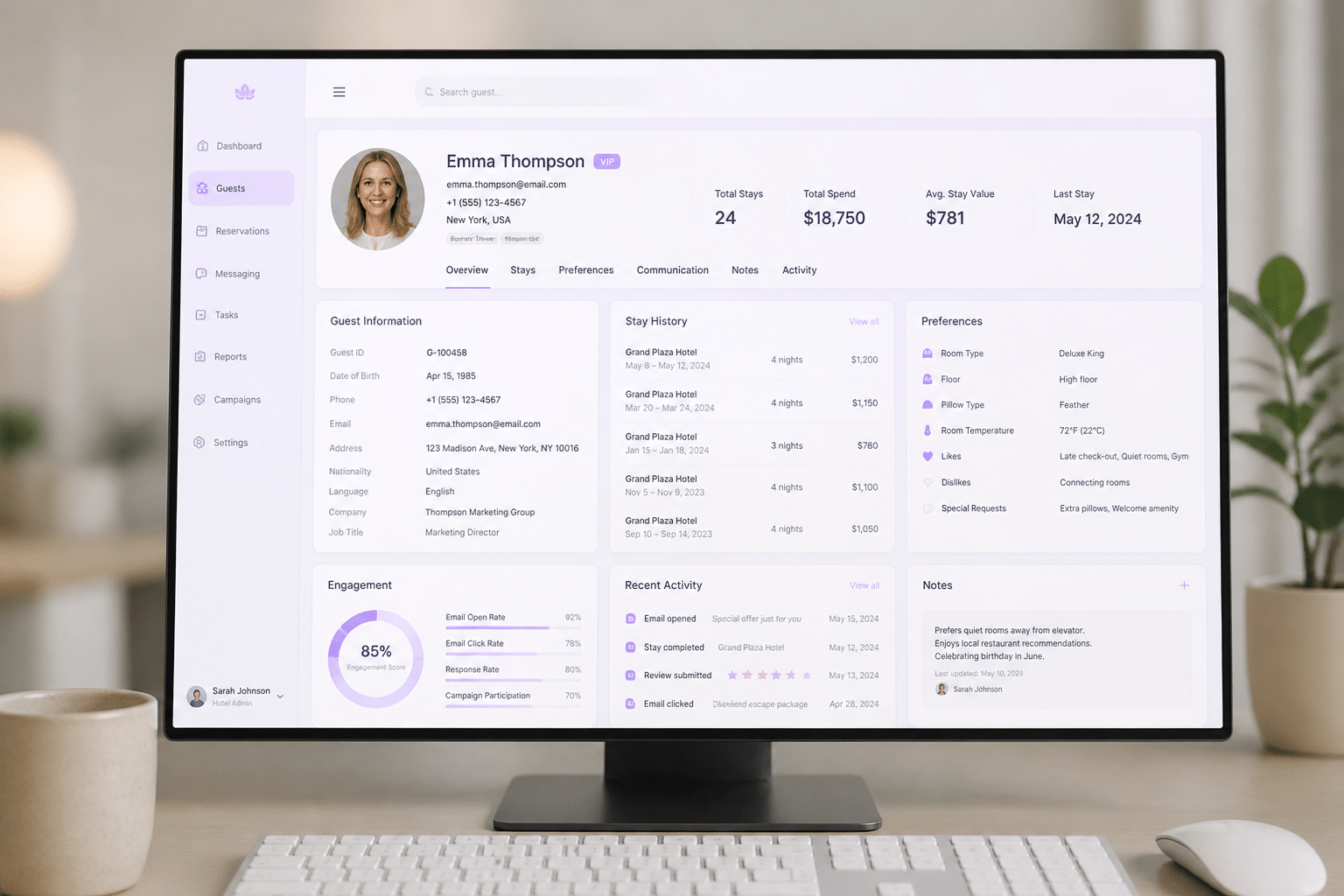
A modern hotel management system like Ease My Hotel keeps guest profiles, stay dates, booking sources and spend in one place. That means segments can update on their own as guests check in and out. Less manual data entry. Fewer mistakes. More time for your team to actually talk to guests.
Once your list is clean and sorted, you’re ready to start writing. Next up: the emails guests get before they even arrive.
The Pre-Stay Sequence: Build Anticipation and Increase Revenue Before Arrival
The booking confirmation is boring. We all know it. A guest gets a receipt, a reservation number, and then total silence until check-in day.
That silence is a missed chance. Between booking and arrival, guests are excited and thinking about their trip. It’s the best time to talk to them.
A Simple Two-Email Timeline
You don’t need ten emails. Two good ones do the job. Purple’s guide to pre-stay and post-stay email sequences points to a simple rhythm, and it works well:
- 7 days out: Inspiration. Share a short local guide, an events calendar for their dates, or a “meet the team” note. Maybe the chef shares a favorite dish, or the front desk lead shares her top coffee spot. Keep it warm and short.
- 2 to 3 days out: Details and one last offer. Add check-in times, directions, parking info and a final upgrade or dining offer.
Notice the first email sells nothing hard. It just makes guests feel looked after. The second one is where the money comes in.
Turning Guest Data Into Smart Upsells
Here’s where your guest data pays off. If you already know who’s coming, why send everyone the same offer? Revinate’s 2026 report puts pre-arrival campaign conversion at about 2.5%. That’s a fair starting point, though results change by offer and guest type. (I’d treat it as a floor, not a ceiling.)
The trick is matching the offer to the person. A guest list with party size, booking source and past spend makes this simple. A unified system like Ease My Hotel keeps those details in one place, so your emails can pull the right offer for the right guest without anyone digging through spreadsheets.
Pre-Stay Personalization Ideas
| If the guest is… | Offer this |
|---|---|
| A couple booking a weekend | Romantic dinner package or room with a view |
| A family with kids | Family activity bundle, extra bed or kids’ breakfast |
| A business traveler | Airport transfer, early check-in or late checkout |
| A returning guest | Favorite room upgrade or a welcome-back drink |
| Someone arriving on a birthday or anniversary | Cake in the room or spa credit |
| A long-stay guest | Laundry package or midweek dining credit |
One rule: only offer what you can actually deliver. Selling an upgrade that’s already booked is a quick way to annoy someone. So make sure your availability updates in real time.
Keep It Light
One main button per email. That’s it. Pick one offer, make the call to action clear, and let the guest decide. If they skip it, no worries. You’ve still made a nice first impression.
Once guests have stayed, the real loyalty work starts. Next up: what to send after checkout.
The Post-Stay Follow-Up: Your Direct Line to Repeat Bookings
The guest has checked out. The bags are in the car. Most hotels go quiet right here, and that’s the mistake.
The days and months after a stay are where repeat bookings get made. Let’s walk through three emails that do the job, one after another.
The 24 to 48 Hour Thank You and Review Email
Send this one fast. One hospitality source says review requests sent within 2 to 4 hours of checkout reportedly get a 22% completion rate, which drops to 6% after 72 hours. I’d treat those numbers as a rough guide, not gospel. But the lesson is clear: guests forget fast.
Keep it short and warm. Say thanks, and (this is the part people skip) mention something real. Maybe it was the room type, the sunset breakfast on the terrace, or the birthday cake you sent up. A line like “We hope the lake view room treated you well” beats “Dear valued guest” every time.
Then make the review easy:
- Add one button each for Google and TripAdvisor.
- Link straight to the review page, not your homepage.
- Keep the subject line simple, like “How was your stay in [Destination]?”
Happy guest? They’ll post. Unhappy guest? Better you hear it in a private reply first.
The ‘We Miss You’ Email at 30 to 90 Days
About two months after checkout, the memory starts to fade. That’s your moment.
Revinate suggests a win-back trigger around 60 to 90 days when a guest hasn’t booked again. Send a friendly note with a reason to return, plus a deadline. Something like: “Book direct by the 30th and enjoy free breakfast on your next stay.”
A couple of tips:
- Lead with a perk, not a discount. Breakfast, late checkout or a spa credit often feels bigger than 10% off.
- Match the offer to the stay. A family gets a kids’ bundle. A business traveler gets a midweek rate.
- Link to your direct booking page and skip guests who already rebooked.
The Win-Back Email for Dormant Guests
No stay in 12 months or more? These guests are drifting. Time for something special.
This email should feel exclusive, like a thank-you for being part of your story. Think early access to a new package, a free room upgrade, or a returning-guest rate you don’t offer anyone else. Say it plainly: “It’s been a while, and we’d love to see you again.” Then add a clear end date.
If they ignore it, send one short reminder 7 to 14 days later. Then stop. Nobody likes a pushy ex.
A PMS like Ease My Hotel can help here. It keeps stay dates in one place, so the right guests land in the right email automatically, without anyone checking a spreadsheet on Friday night.
The Whole Sequence at a Glance
| Step | When it sends | Goal | Best offer |
|---|---|---|---|
| 1. Thank You and Review | 24 to 48 hours after checkout | Get a review, show you care | A review link, no discount |
| 2. ‘We Miss You’ | About 60 days after the stay | Prompt the next booking | Free breakfast or late checkout, with a deadline |
| 3. Win-Back | 12 months or more with no stay | Bring back lapsed guests | Exclusive upgrade or returning-guest rate |
Set it up once and it runs in the background. Next, let’s look at how to make every one of these emails feel like it was written for one person.
Hyper-Personalization: Using Guest Data to Create Unforgettable Touches
“Hi [First Name]” isn’t personal. It’s a mail merge. Guests know it, and honestly, they stopped noticing years ago.
Real personalization means sending the right message at the right moment, based on what a guest actually did. That’s where your guest data earns its keep.
Milestone Emails: Birthdays and Anniversaries
A birthday email is one of the easiest wins in hotel email marketing. The data’s already in your system, and the timing writes itself.
Send it a week or two before the date. Keep the gift small and real: a free dessert, a welcome drink, or a spa credit. A small treat feels like a hug. A random 10% off feels like a coupon.
Revinate’s 2025 hospitality benchmark says birthday emails generated higher booking values than other recurring email types. I couldn’t find a solid public number for birthday click or conversion rates, though. So track your own results against a small control group.
The Booking Anniversary Email
This one’s my favorite. Exactly one year after a guest’s stay, send a note that says, “A year ago today, you were with us.”
Here’s how to build it:
- Open with a photo of the room, the view or the restaurant they enjoyed.
- Mention one real detail, like the room type or the month they visited.
- Add a “Come Back and Make New Memories” offer, such as free breakfast or a room upgrade.
- Set an end date and link straight to your direct booking page.
It works because it feels like a memory, not a sales pitch. And for couples who stayed on an anniversary trip? Pure gold.
Behavior Triggers: Sending Based on What Guests Do
Milestones follow the calendar. Behavior triggers follow the guest.
Take a guest who booked a spa treatment last time. When your new spa menu launches, tell them first. Or a guest who started a booking on your website but never finished. A quick reminder can bring them back.
Timing matters here. Industry guidance suggests sending the first abandoned booking email within 20 to 60 minutes, with follow-ups after about 24 hours and again at 48 to 72 hours. Recovery rates vary a lot. A cautious plan is 5 to 10% of reachable abandoners, and anything above 10% is strong.
To run these, your system needs to know who spent what and who left a booking half done. A unified platform like Ease My Hotel keeps guest profiles, stay history and booking data together, so triggers fire without anyone watching a spreadsheet.
Automated Campaigns That Drive Loyalty
| Campaign type | Trigger | Audience | Sample offer | Primary goal |
|---|---|---|---|---|
| Birthday | 7 to 14 days before the guest’s birthday | Past guests with a birthday on file | Free dessert or welcome drink | Prompt a celebration stay |
| Booking anniversary | 1 year after checkout | Guests who stayed 12 months ago | Free breakfast on a return stay | Bring back past guests |
| Abandoned booking | Guest leaves booking page after entering an email | Direct website visitors | Reminder plus late checkout | Recover lost bookings |
| Spa or dining promo | New menu or package launch | Guests who bought that service before | Early access or a small credit | Grow extras spend |
| Win-back | No stay in 12 months | Lapsed guests | Returning-guest rate | Reactivate dormant guests |
Start with one campaign, not five. Get it running, check the results, then add the next. Once your emails feel personal, you can also give guests something that isn’t an offer at all. That’s up next.
Beyond the Sale: Building a Community with Value-Driven Content
Here’s a question. When did you last open an email just because it was useful, not because it had a coupon? That’s the feeling we want guests to have about your hotel.
Every email so far has had a job: book, review, return. But a guest who only hears from you when you want money will tune out fast. A regular newsletter fixes that.
Why a Newsletter Beats Another Discount Blast
A good newsletter keeps your hotel in a guest’s mind between stays. No pressure. Just a friendly hello that’s worth reading.
Phocuswright’s 2025 loyalty research found that 53% of travelers see using a brand over a long period as a key sign of loyalty. Loyalty is built slowly, so your emails should show up slowly and kindly too.
Here’s a simple rule of thumb I like (it’s my own framework, not an industry law): about 70% useful destination content, 20% hotel stories, and 10% offers. Mews suggests mixing seasonal offers with local events, testimonials and behind-the-scenes stories. Once a month is plenty. And one main button per issue.
15 Hotel Newsletter Ideas Your Guests Will Actually Read
Stuck for topics? Start here:
- A local events guide for the next 30 days
- A staff spotlight, like the night manager who knows every shortcut in town
- A chef’s recipe from your hotel restaurant
- A “48 hours in [destination]” itinerary
- A hidden gem guide (the bakery tourists miss)
- Seasonal packing tips for your area
- A “locals’ favorites” food list
- Behind-the-scenes photos of a room refresh
- A guest photo of the month, shared with written permission
- A short Q&A with your concierge
- New spa or dining menu previews
- A sunrise or sunset spot guide
- Family or pet-friendly activity picks
- A holiday and festival calendar
- A “what’s new this season” update
Pick two or three per issue. Don’t try them all at once.
Turning Readers Into Loyal Fans
This is where newsletters start paying you back. If you run a loyalty program, give it a spot in every issue. Share a member perk, a points update, or a quick reminder of what members get on direct bookings.
Then add something only members see. Early access to a seasonal package. A members-only recipe. A first look at a new room. People love feeling like insiders, and insiders tell their friends.
Keep your guest list sorted, and your newsletter can speak to families, couples and business travelers differently. A unified system like Ease My Hotel keeps that guest data in one place, so the right story reaches the right inbox.
So how do you know any of this is working? That’s next.
Measuring What Matters: How to Track and Optimize Your Email ROI
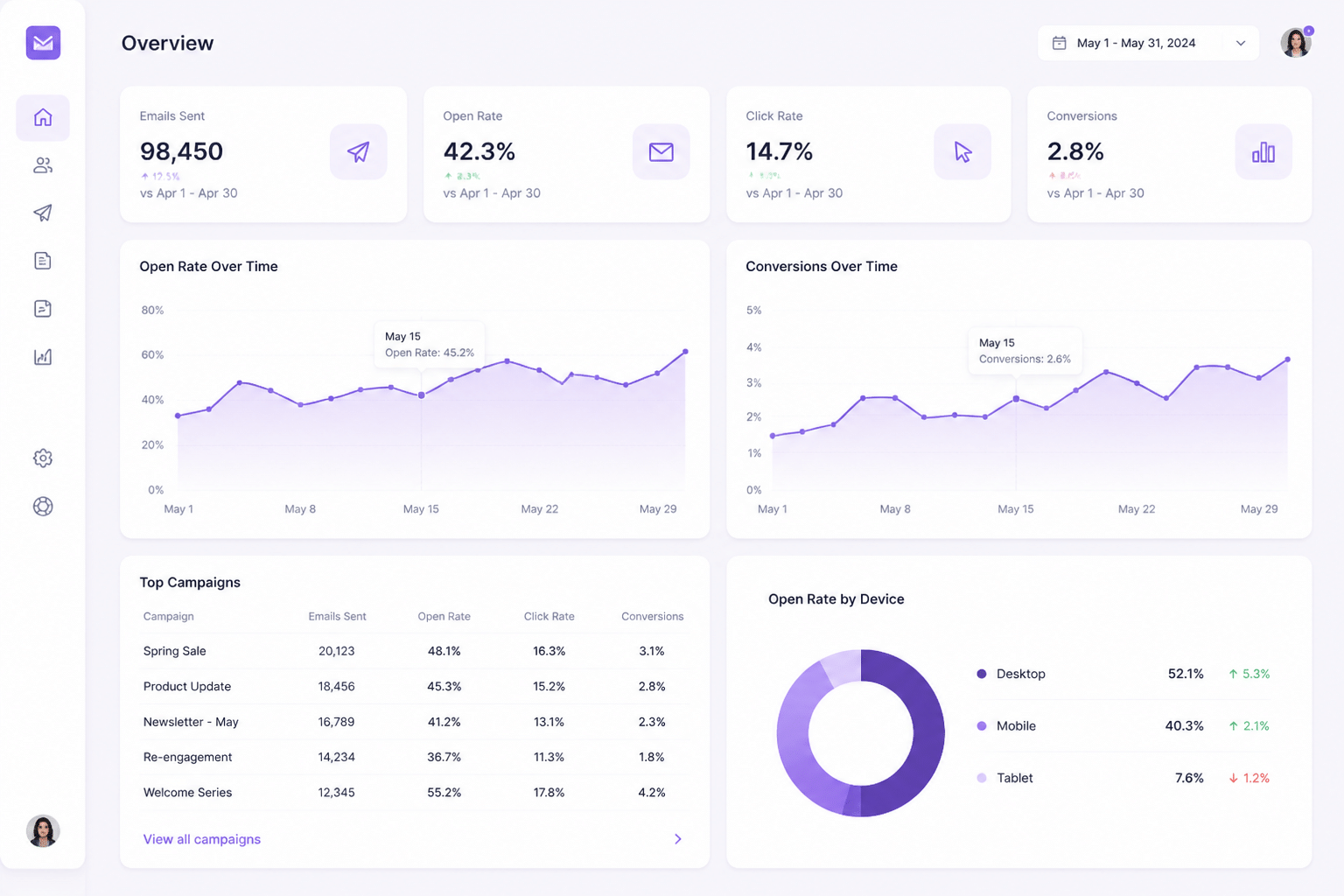
You’ve sent the emails. Now the big question: did they actually bring in bookings? Opens feel nice. Rooms sold feel better.
The 5 Numbers Worth Watching
You don’t need a giant report. Five numbers tell most of the story. Benchmarks below come from a 2026 hospitality email benchmark report, and I’d treat them as rough targets, not rules.
| Metric | What it tells you | Rough benchmark |
|---|---|---|
| Open rate | Whether your subject line worked | About 30% for broad sends, around 43% for small segments |
| Click-through rate (CTR) | Whether the content and button grabbed interest | About 2% broad, around 4% segmented |
| Conversion rate | How many clicks became direct bookings | About 0.5% for well-segmented sends |
| Unsubscribe rate | Whether you’re sending too much or the wrong thing | No firm hotel number, so watch for sudden jumps |
| Revenue per email | What each send actually earned you | Property-specific, so track your own |
Revenue per email is the one that matters most. Add up the booking revenue from a campaign, divide by emails delivered, and you’ve got it. One caution: Apple Mail privacy features can inflate open rates. So don’t crown a winner on opens alone.
A/B Testing in Plain English
Sounds fancy. It isn’t. You send two versions of one email to two small, random groups, then see which does better. The winner goes to everyone else.
The golden rule: change one thing at a time. Here’s what’s worth testing:
| Test | Version A | Version B |
|---|---|---|
| Subject line | “Save 15% on your next stay” | “Your late checkout and spa credit are waiting” |
| Button text | “Book Now” | “Explore Offer” |
| Imagery | Room photo | Local view or food photo |
| Send time | Tuesday morning | Sunday evening |
Judge by bookings, not just opens. A subject line that wins opens but loses bookings isn’t a winner. (Ask me how I know.) Start with subject lines, since they’re the quickest to test.
Seeing Revenue in One Place
Here’s where scattered tools hurt. If emails live in one app and bookings in another, you’re guessing which campaign paid off.
A centralized dashboard fixes that. Some platforms, like Revinate’s marketing automation, credit a booking to an email using a 30-day lookback and last-touch rule, and the guest must open or click first. That’s a fair model to copy.
With a unified system like Ease My Hotel, guest profiles, stay history and bookings sit together. So you can line up each campaign with the direct bookings and revenue it produced. Check the exact reporting features with the team first, though.
Once you can prove what works, it’s time to put it all together.
Turn Your Email List into Your Most Profitable Asset
Let’s circle back to that guest who checked out on Sunday and never heard from you again. Now you know how to change that story.
Here’s the short version. Build a list people actually agreed to join, and sort it into small groups. Warm guests up before they arrive. Follow up after they leave. Use what you know about them to send things that feel personal. Share useful stuff, not just offers. And check the numbers, so you keep what works and drop what doesn’t.
That’s the whole plan. Not ten new tools. Just a steady habit.
Your First Step Today
Here’s what I’d do before lunch. Audit how you’re collecting guest emails right now. Where do they come from? Is marketing permission separate from the booking confirmation? Can your current system sort guests by stay history, booking source and spend without a spreadsheet?
If the answer to that last one is “not really,” that’s your starting point. It’s the foundation of everything else.
Why a Unified System Makes It Stick
Honestly, most of us don’t fail at email because we lack ideas. We fail because guest data lives in five places, and nobody has time to stitch it together. A cloud-based platform like Ease My Hotel keeps profiles, bookings, guest communication and reporting in one dashboard. So the campaigns we talked about can run in the background while your team does what it does best: looking after guests.
The payoff? More direct bookings, more repeat guests, and less money chasing strangers on OTAs.
Ready to put your guest list to work?
See how Ease My Hotel’s marketing and guest communication features can help you turn past guests into repeat bookings. Visit Ease My Hotel and take a look.
Try Ease My Hotel for free.
No lock-in contracts. Cancel anytime